

May 30, 2026
I grew up in a village inside Angkor Wat. My grandfather was the Grand Abbot of the pagoda within the temple walls. As a child, I shaved my head and pretended to be a boy so the monks would let me stay. I learned Sanskrit on palm leaves, swam in the temple pools during rainy season, and fell asleep to the sound of bats circling the central towers.
That temple is my home. And after more than 10 years running tours through it, I want to share what I wish every traveler knew before arriving. The Angkor Archaeological Park spans 400 square kilometers with 72+ major temples (UNESCO). Most visitors see three of them. This guide will help you see the ones that matter, at the right pace, with the right context.
KEY TAKEAWAYS
- Tickets: $37 (1-day), $62 (3-day), $72 (7-day). Kids under 12 free with passport.
- Best months: November-February, 22-32°C, under 25mm rain (Climate-Data.org).
- How many days: Minimum 2, ideal 3. One day is too rushed.
- Dress code: Cover shoulders and knees. Enforced at the upper level.
- Sunrise tip: Arrive by 5:00 AM but skip the crowded reflecting pool. Walk inside the temple instead.
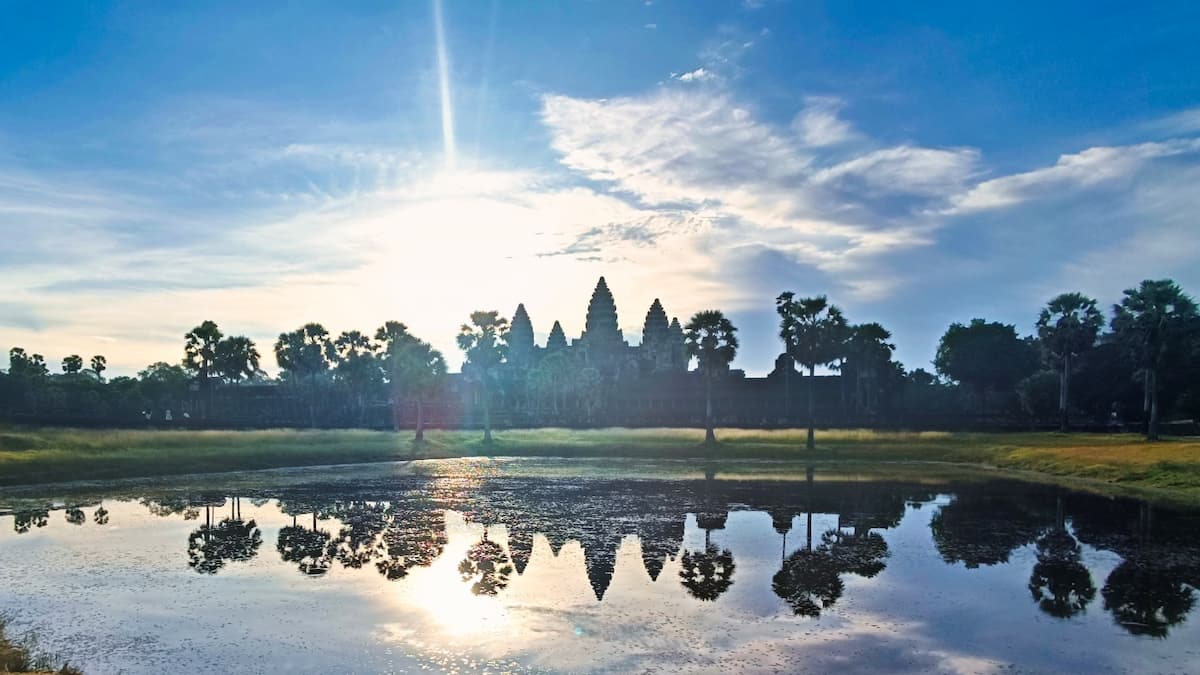
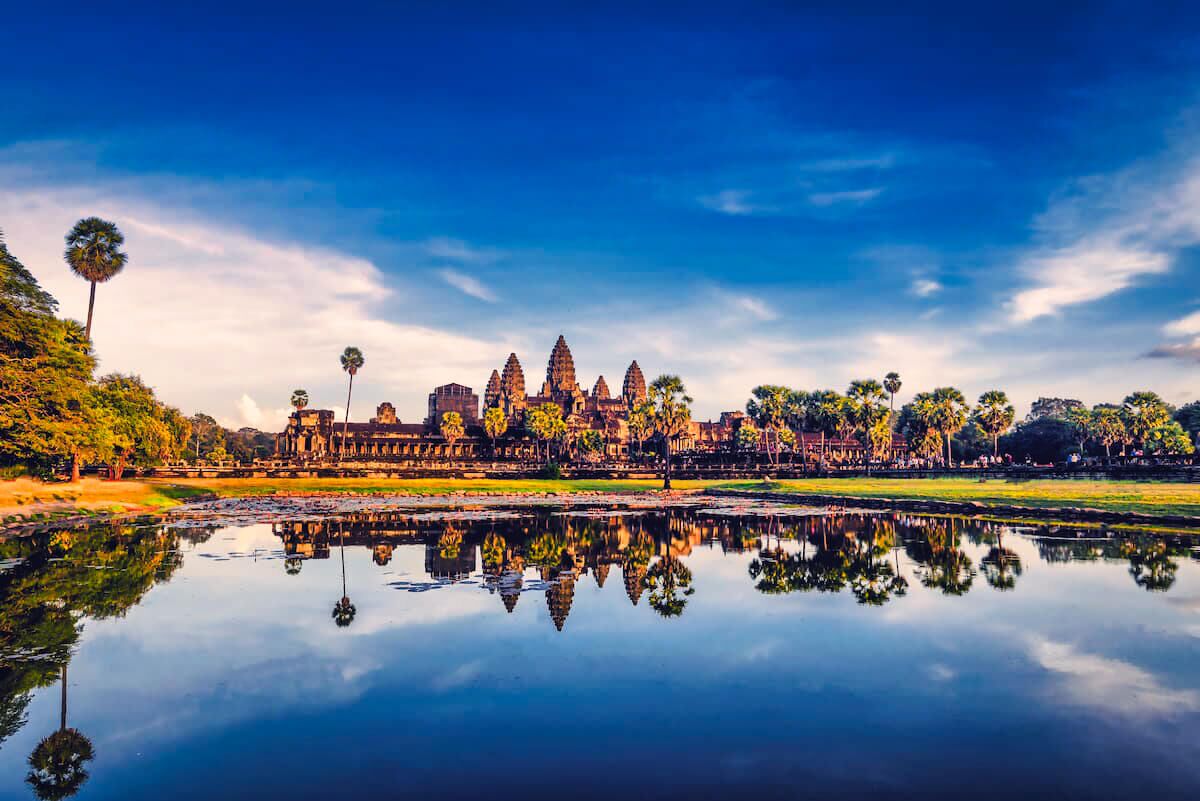
Sunrise at Angkor Wat’s reflecting pool.
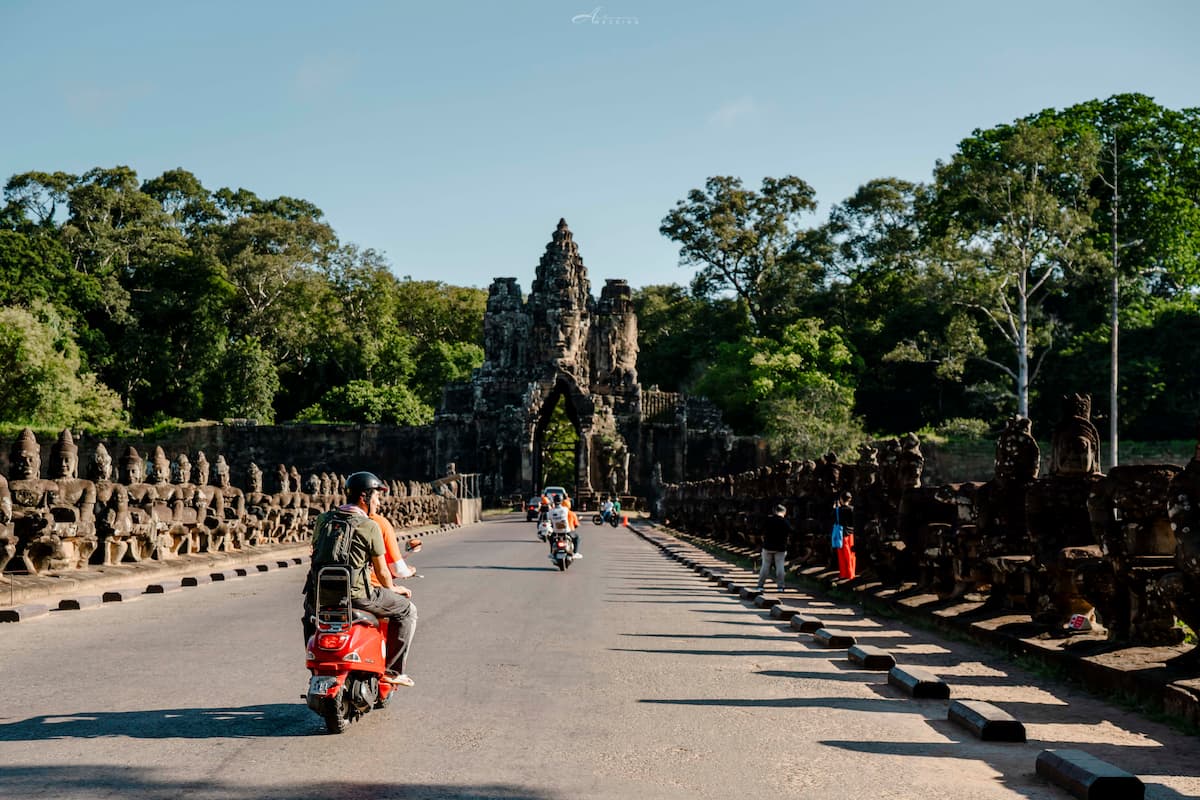
The iconic face towers at Angkor Thom’s south gate.
What Is Angkor Wat and Why Does It Matter?
Angkor Wat is the largest religious monument on Earth, covering 162.6 hectares. King Suryavarman II built it between 1113 and 1150 CE as a Hindu temple dedicated to Vishnu. UNESCO inscribed it as a World Heritage Site in 1992, recognizing both its architectural genius and its living spiritual role.
But here’s what statistics don’t tell you. Walk through the western gate at dawn, and you’ll hear monks chanting before any tour group arrives. The sandstone is cool under your feet. Incense drifts from the inner galleries. This isn’t a ruin. It’s a place where people still pray, still make offerings, still bring their children to learn the old stories.
Understanding the role of water at Angkor helps explain why the temple was built here, surrounded by a moat that stretches 1.5 kilometers on each side.
Angkor Wat vs Angkor: What’s the Difference?
Visitors confuse these two names constantly. Angkor Wat is one temple. The Angkor Archaeological Park is a 400 square kilometer area containing 72+ temples, cities, reservoirs, and ancient infrastructure (UNESCO). Think of it this way: Angkor Wat is the star, but the park is the entire constellation.
Your Angkor pass gives you access to the whole park, not just Angkor Wat. That’s why I always recommend at least two days. You can’t appreciate the scale of this place in a single morning.
What the Equinox Reveals About Angkor
Twice a year, on March 21-23 and September 21-23, the sun rises directly over Angkor Wat’s central lotus tower (Wikipedia). This isn’t an accident. The ancient Khmer builders aligned the entire temple to astronomical precision, encoding their understanding of the solar cycle into stone.
I’ve watched the equinox sunrise from inside the temple dozens of times. The light hits the central tower first, then spills down the western causeway like liquid gold. Most guides don’t mention this. No competitor guide I’ve read covers it either. If your visit falls near those dates, arrive by 5:00 AM and position yourself on the western approach.
Why Cambodians Still Pray Here Today
My grandfather served as Grand Abbot of the pagoda inside Angkor Wat for decades. He taught me that this temple never stopped being sacred. Even during the darkest years of Cambodia’s history, monks returned here to pray.
On full moon days, Cambodian families still arrive with lotus flowers and incense. They kneel on the stone floor of the inner galleries. I grew up watching my grandmother place offerings at the base of a Vishnu statue that’s been standing for 900 years. When our guides lead tours today, they always point out the fresh flowers. They’re a reminder that Angkor Wat isn’t a museum. It’s alive.
Which Temples Should You Visit at Angkor?
Every visitor should see the big three: Angkor Wat, Bayon, and Ta Prohm. In 2025, 955,131 foreign visitors explored the park (Travel and Tour World), yet most only scratched the surface. The park holds 72+ temples, and some of the most powerful ones sit empty most days.
Here’s my honest ranking after running thousands of tours. Start with these, then go deeper if your schedule allows.
Angkor Wat
The main temple deserves at least two hours. Don’t rush through it. The outer gallery contains nearly 600 meters of continuous bas-reliefs depicting scenes from Hindu mythology. Read more about what the bas-reliefs mean before your visit.
Start at the western entrance and work counterclockwise. The Churning of the Ocean of Milk on the eastern gallery is the most famous panel, but my favorite is the Army of Suryavarman II on the south side. You can see individual soldiers, war elephants, and even Chinese mercenaries carved in extraordinary detail.
I’ve walked these galleries thousands of times, and I still notice new details. Last month, a guest pointed out a figure I’d somehow missed in 10 years. That’s the thing about Angkor Wat. It keeps revealing itself.
HOURS
5:00 AM – 6:30 PM
Daily, year-round
BEST TIME
Sunrise or 3-5 PM
Softest light, fewer crowds
CROWDS
High
Busiest 9-11 AM
TIME NEEDED
2-3 hours
Don’t rush this one
MY PICK
Skip the reflecting pool at sunrise. Walk inside the temple through the western entrance. The corridors glow amber, and you’ll share the space with maybe five other people. This is the Angkor Wat moment every visitor deserves.
Angkor Thom and Bayon
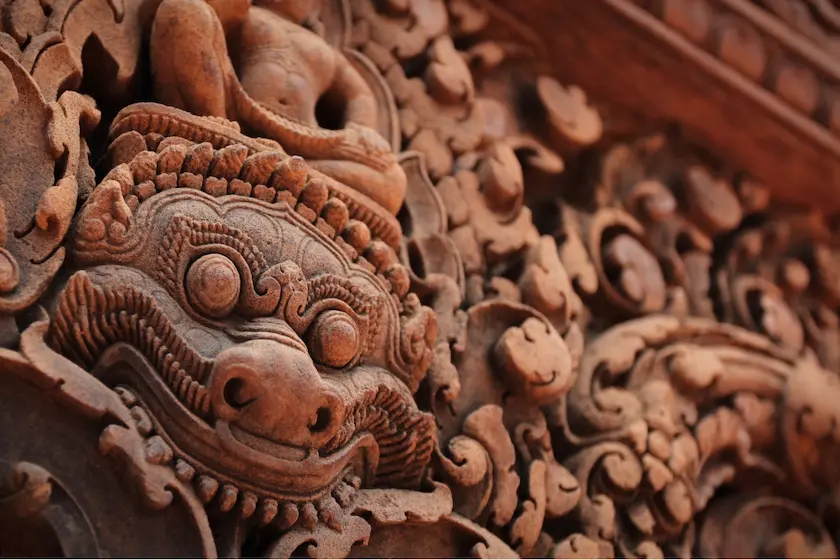
Angkor Thom was the last great capital of the Khmer Empire, a walled city covering 9 square kilometers. At its center sits Bayon, the temple with 216 massive stone faces smiling down at you from every angle.
Bayon is best visited in the late afternoon, when golden light catches the faces and the tour buses have left. Climb to the upper terrace. Find a quiet corner. Sit with one of those faces and just look. That’s when you feel it.
HOURS
6:00 AM – 6:30 PM
Inside Angkor Thom
BEST TIME
Late afternoon
Golden light on the faces
CROWDS
Medium-High
Quieter after 3 PM
TIME NEEDED
1-1.5 hours
Climb to the upper terrace
MY PICK
Find the northeast corner of the upper terrace around 4:30 PM. The light turns the stone faces gold. Most groups have already left. Sit on the warm stone and just be still with one of those faces. That’s when Bayon gives you something no photograph can carry home.
Ta Prohm
Yes, it’s the “Tomb Raider temple.” Yes, it’s crowded. Visit anyway. The strangler figs and silk-cotton trees consuming the stone walls are genuinely extraordinary. No photograph captures the scale of roots pouring over doorways like frozen waterfalls.
Come early or late to avoid the worst crowds. Before 8:00 AM works best. The light filtering through the canopy in the morning is something I never get tired of seeing, even after all these years.
HOURS
6:00 AM – 6:30 PM
Daily, year-round
BEST TIME
Before 8:00 AM
Morning canopy light
CROWDS
Very High
Most visited after Angkor Wat
TIME NEEDED
45 min – 1 hour
Go slow, look up often
MY PICK
Arrive before 7:30 AM and walk east, against the flow. Most groups enter from the west. Going the opposite direction means you’ll see the famous tree roots with nobody standing in front of them. The morning light through the jungle canopy is something I never get tired of, even after all these years.
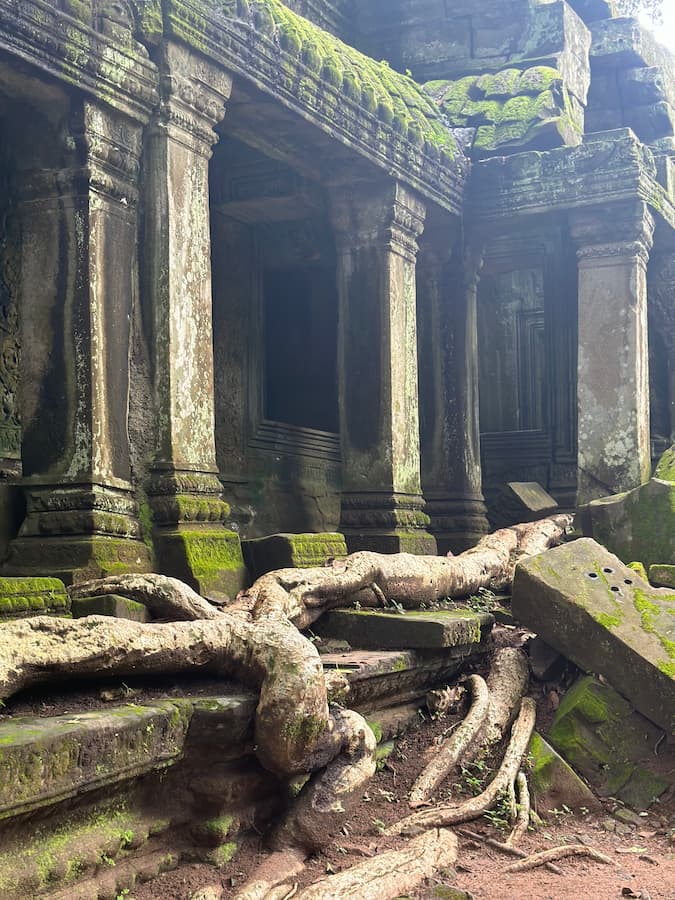
Moss-covered columns and ancient roots.
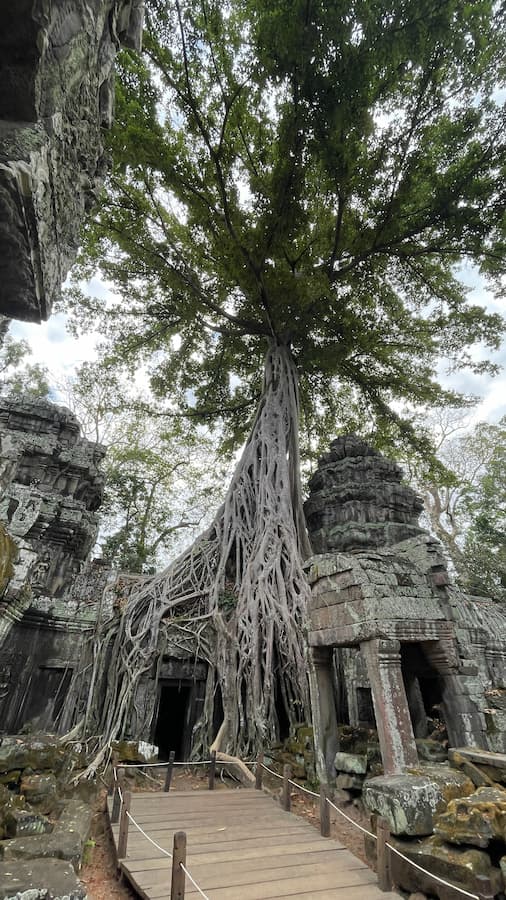
Strangler fig consuming a stone entrance.
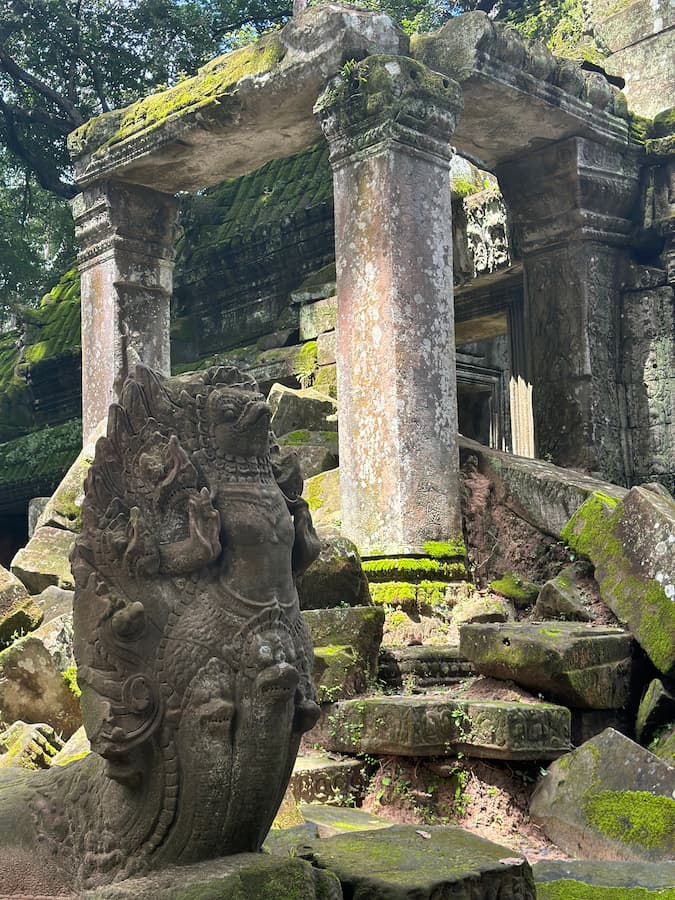
Naga balustrade among the ruins.
Terrace of the Elephants and Terrace of the Leper King
These connected terraces along Angkor Thom’s central axis are often overlooked. The Terrace of the Elephants stretches 300 meters, carved with life-size elephants, garudas, and hunting scenes. The Terrace of the Leper King has extraordinary multi-layered carvings of underworld deities.
Walk the full length. Most groups stop at one end and take photos. The best carvings are halfway along, where fewer people pause.
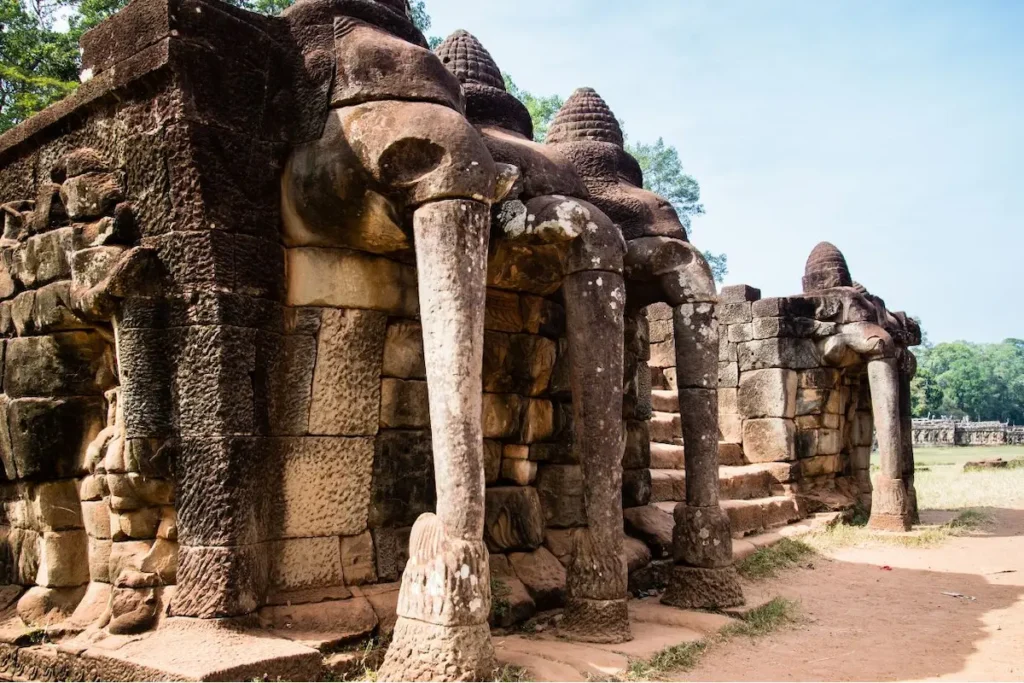
Terrace of the Elephants.
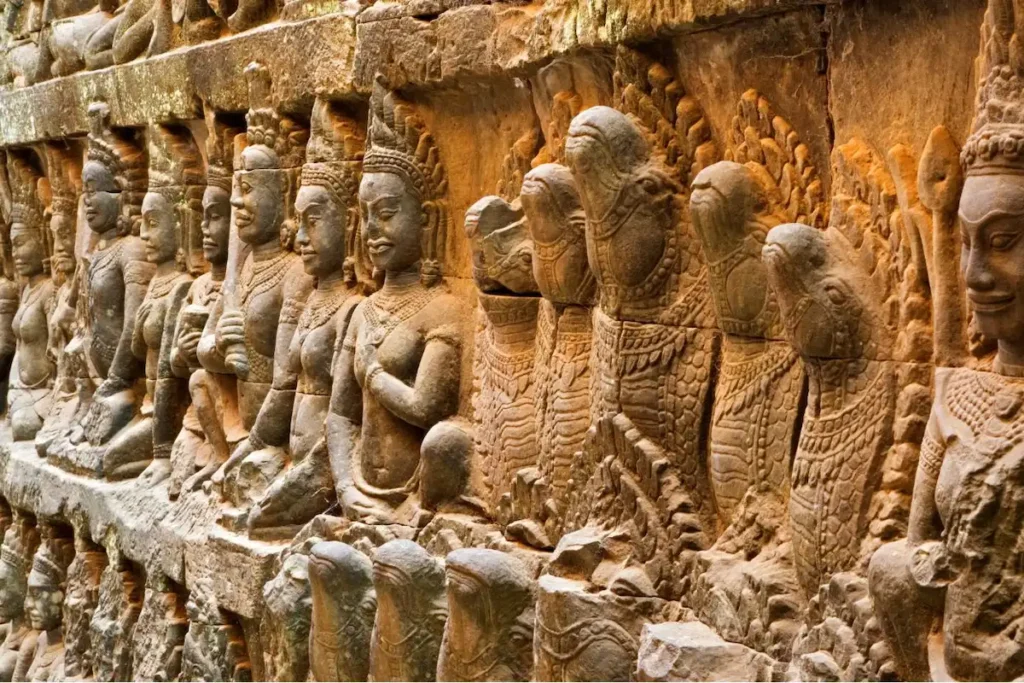
Terrace of the Leper King.
Preah Khan
Preah Khan is my personal favorite for repeat visitors. It’s larger than Ta Prohm but receives a fraction of the tourists. The temple was a Buddhist university that once housed over 1,000 teachers. Walk all the way through from west to east, and you’ll pass through galleries where monks once debated philosophy.
Look for the two-story structure near the eastern entrance. It’s the only building of its kind in all of Angkor.
When the park is crowded, this is where I bring my guests. We can stand in the central sanctuary and hear nothing but birdsong. That silence is worth more than any photograph.
HOURS
6:00 AM – 6:30 PM
Grand Circuit temple
BEST TIME
Any time of day
Always quieter than Ta Prohm
CROWDS
Low
Hidden gem of Angkor
TIME NEEDED
1-1.5 hours
Walk the full east-west axis
MY PICK
This is my favorite temple at Angkor. Walk the full east-west axis without stopping, and you’ll pass through gallery after gallery where Buddhist monks once studied and debated. On a quiet morning, the only sound is birdsong echoing through the stone corridors. Our guests often say this temple moved them more than Angkor Wat.
Banteay Srei
This small temple sits 25 kilometers northeast of the main park, and the drive is worth every minute. The pink sandstone carvings at Banteay Srei are the finest in all of Khmer art. The detail is so precise it looks like carved wood, not stone. Read the full story of Malraux and Banteay Srei to understand why a French novelist tried to steal these carvings in 1923.
Visit in the morning when the pink stone glows warmest. A three-day pass gives you time to include this temple comfortably.
HOURS
6:00 AM – 6:30 PM
25 km from main park
BEST TIME
Morning
Pink stone glows in warm light
CROWDS
Medium
Popular but manageable
TIME NEEDED
45 min – 1 hour
Small but incredibly detailed
MY PICK
Look at the lintel above the eastern entrance. The scene shows Ravana shaking Mount Kailasa, with Shiva sitting calmly on top. The carving is so fine that Andre Malraux tried to steal panels from this temple in 1923. He got caught. The carvings stayed. You can still see exactly what he was willing to go to prison for.
Phnom Bakheng
The hilltop temple famous for sunset views. Honest answer: it’s overcrowded at sunset and the experience can feel like standing in a queue on a mountaintop. I prefer Pre Rup for sunset instead. Fewer crowds, equally beautiful light, and you can actually sit in peace.
If you do climb Phnom Bakheng, arrive by 4:00 PM. Only 300 visitors are allowed on top at a time.
HOURS
5:00 AM – 7:00 PM
Stays open for sunset
BEST TIME
Sunrise (not sunset)
Skip the sunset crowds
CROWDS
Very High at sunset
300-person cap enforced
TIME NEEDED
30-45 min
Plus 15 min steep climb
Roluos Group: The Oldest Angkor Temples
Bakong, Lolei, and Preah Ko sit about 13 kilometers east of Siem Reap. These are the oldest temples in the Angkor area, predating Angkor Wat by over 200 years. Almost no tourists visit them.
This is where you go to understand how Khmer temple architecture evolved. Bakong’s stepped pyramid design became the blueprint for every temple mountain that followed, including Angkor Wat itself. Standing at Bakong, you can see the DNA of everything that came after. If you have a three-day pass, the Roluos Group makes a perfect quiet morning before the main circuits.
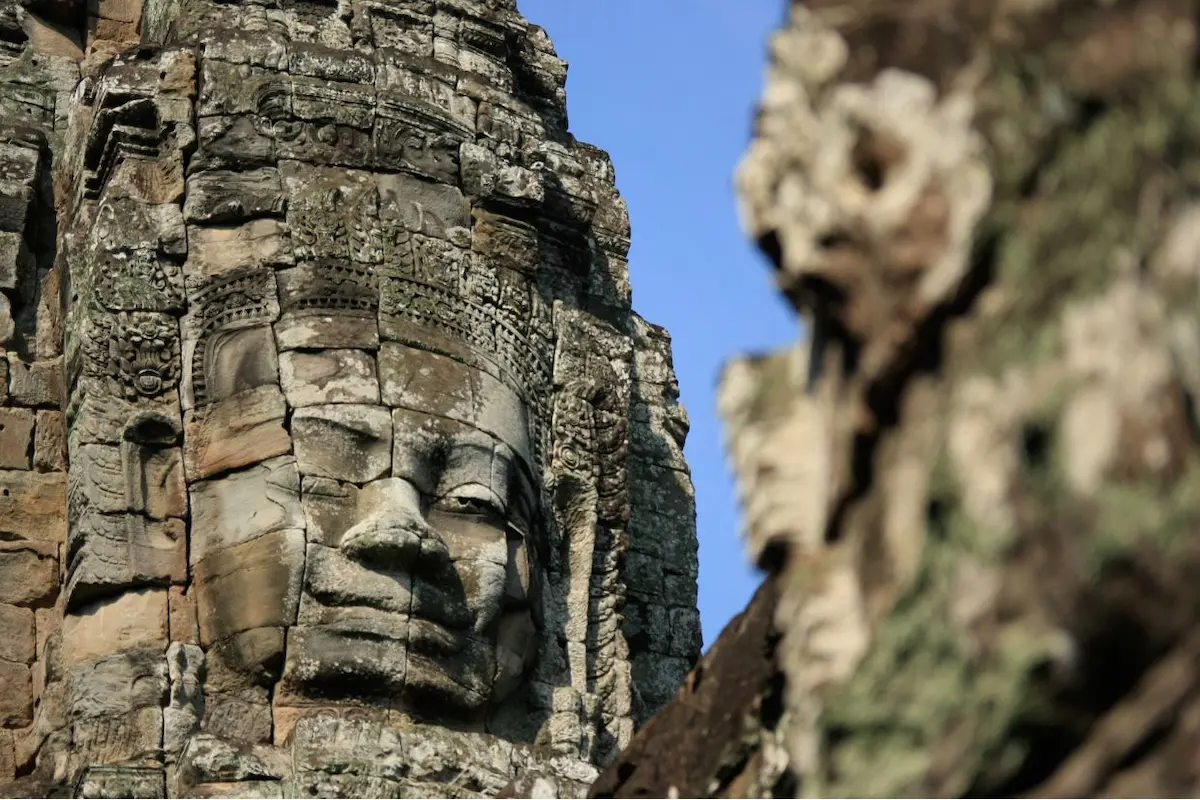
The enigmatic stone faces of Bayon.
Strangler fig trees consuming Ta Prohm.
How Much Do Angkor Tickets Cost in 2026?
A one-day Angkor pass costs $37, a three-day pass is $62, and a seven-day pass is $72 (Angkor Enterprise). Children under 12 enter free with a passport. The three-day pass offers the best value at $20.67 per day, and you can use it on any three days within a 10-day window.
| Pass Type | Price | Cost Per Day | Validity Window |
|---|---|---|---|
| 1-Day Pass | $37 | $37.00 | Single day |
| 3-Day Pass | $62 | $21 | Any 3 days in 10 days |
| 7-Day Pass | $72 | $10 | Any 7 days in 1 month |
| Children under 12 | Free | Free | Passport required |
Source: Angkor Enterprise, 2026. The 3-day pass offers the best value for most visitors.
Buy your pass at the main ticket office on Apsara Road, about 4 kilometers from the temples. You’ll need your passport. The office opens at 5:00 AM for those catching sunrise. Photo ID is taken on-site, so you can’t share passes.
A portion of ticket revenue funds temple conservation and local community programs. For current prices and details, check the Cambodia currency guide so you know what to expect with payments.
How Many Days Do You Need at Angkor?
You need a minimum of two days. Three days is ideal. In over 10 years of running tours, the number one regret I hear from guests is “I wish I had more time.” Visitors who try to see everything in one day leave exhausted and remember almost nothing. Temples need silence, context, and rest breaks between them.
Small Circuit vs Grand Circuit
The Small Circuit itinerary covers the essential temples: Angkor Wat, Angkor Thom, Bayon, Ta Prohm, and Banteay Kdei. It takes a full day with breaks. The Grand Circuit adds Preah Khan, Neak Pean, Ta Som, and East Mebon. These are less crowded and genuinely rewarding.
With two days, you do one circuit per day. With three, you add Banteay Srei, the Roluos Group, or a morning at Ta Keo temple.
Sample Itineraries
1-DAY EXPRESS
5:00 AM
Sunrise at Angkor Wat
9:00 AM
Angkor Thom + Bayon
1:00 PM
Ta Prohm, Kravan
Sunrise at Angkor Wat
9:00 AM
Angkor Thom + Bayon
1:00 PM
Ta Prohm, Kravan
Tight but covers essentials
2-DAY RECOMMENDED
Day 1: Small Circuit
Angkor Wat, Bayon, Ta Prohm, Banteay Kdei
Day 2: Grand Circuit
Preah Khan, Neak Pean, Ta Som, East Mebon
Angkor Wat, Bayon, Ta Prohm, Banteay Kdei
Day 2: Grand Circuit
Preah Khan, Neak Pean, Ta Som, East Mebon
Best balance of temples and pace
3-DAY IDEAL
Day 1: Small Circuit
Angkor Wat, Bayon, Ta Prohm, Banteay Kdei
Day 2: Grand Circuit
Preah Khan, Neak Pean, Ta Som, East Mebon
Day 3: Outside Temples
Banteay Srei, Beng Mealea, Roluos Group
Angkor Wat, Bayon, Ta Prohm, Banteay Kdei
Day 2: Grand Circuit
Preah Khan, Neak Pean, Ta Som, East Mebon
Day 3: Outside Temples
Banteay Srei, Beng Mealea, Roluos Group
Time to absorb what you’re seeing
One-day express. Sunrise at Angkor Wat (5:00 AM). Angkor Thom and Bayon (9:00 AM). Ta Prohm and Kravan (1:00 PM). This is tight but covers the essentials.
Two-day recommended. Day 1: Small Circuit with Angkor Wat, Bayon, Ta Prohm, and Banteay Kdei. Day 2: Grand Circuit with Preah Khan, Neak Pean, Ta Som, and East Mebon. This is what I recommend for most guests.
Three-day ideal. Day 1: Small Circuit. Day 2: Grand Circuit. Day 3: Banteay Srei and Beng Mealea, plus time to revisit favorites. This pace lets you actually absorb what you’re seeing.
When Is the Best Time to Visit Angkor?
November through February is the best time for most visitors. Temperatures range from 22-32 degrees Celsius and rainfall drops below 25 millimeters per month (Climate-Data.org). Skies are clear, humidity is manageable, and the temples photograph beautifully in the crisp dry-season light.
| Month | High Temp | Rainfall | Crowds | Rating |
|---|---|---|---|---|
| Jan | 32°C | ~10mm | High | Excellent |
| Feb | 34°C | ~12mm | High | Excellent |
| Mar | 36°C | ~40mm | Medium | Good |
| Apr | 38°C | ~70mm | Low | Hot |
| May | 36°C | ~160mm | Low | Mixed |
| Jun | 34°C | ~180mm | Low | Green season |
| Jul | 33°C | ~190mm | Low | Green season |
| Aug | 33°C | ~210mm | Low | Green season |
| Sep | 33°C | ~286mm | Very Low | Wettest month |
| Oct | 32°C | ~250mm | Low | Green season |
| Nov | 31°C | ~100mm | Medium | Very Good |
| Dec | 32°C | ~25mm | High | Excellent |
Source: Climate-Data.org. Rainfall and temperature are monthly averages for Siem Reap.
March and April are the hottest months. Temperatures regularly hit 38 degrees, and the heat radiating off exposed sandstone makes afternoon temple visits genuinely unpleasant. January rainfall averages just 10 millimeters, while September sees roughly 286 millimeters (Climate-Data.org).
But don’t rule out every month outside the peak window. Each season has trade-offs, and the “worst” months sometimes deliver the best experiences.
The Rainy Season Secret
The rainy season is my favorite time at Angkor. I know that sounds counterintuitive. But hear me out. From June through October, the moats fill completely, the grass turns impossibly green, and dramatic cloud formations make every sunrise unique. You might have Bayon entirely to yourself at 7:00 AM.
Rain usually falls in the afternoon, lasting one to two hours. Mornings are clear. We’ve run hundreds of rainy-season tours, and guests consistently tell us it was better than they expected. The temples look different surrounded by water. They look the way the Khmer builders intended them to look.
What Should You Wear to Angkor Temples?
Cover your shoulders and knees. This dress code is enforced at Angkor Wat’s upper level, the Bakan, where guards check every visitor before allowing entry. Lightweight, breathable fabric is essential because you’ll be walking in tropical heat for hours.
Wear loose trousers or a long skirt, a t-shirt that covers your shoulders, and comfortable walking shoes. Flip-flops work on flat ground but are dangerous on the steep temple stairs. I recommend light sneakers or sport sandals with a back strap.
You Will Be Turned Away at the Upper Level
IMPORTANT – DRESS CODE ENFORCED
Guards at the Bakan (upper level) of Angkor Wat check every visitor. You must cover your shoulders and knees. Tank tops, short skirts, and shorts above the knee are not allowed. No exceptions. If you’re turned away, you’ll need to walk back, change, and re-queue.
I’ve seen it happen hundreds of times. A visitor walks the entire Angkor Wat complex, climbs the queue for the Bakan, and gets refused at the top because their shorts are above the knee. It’s frustrating, and it’s completely avoidable.
The dress code applies to both men and women. No tank tops, no shorts above the knee, no see-through clothing. If you forget, vendors outside sell lightweight elephant-print trousers for $3-5. Not fashionable, but they work.
What Are the Most Important Tips for Visiting Angkor?
Pacing is everything. After running thousands of tours across 10+ years, the biggest mistake I see is cramming too many temples into one day. Temples need silence and context, not speed. Slow down, take breaks in the shade, and actually look at what’s in front of you.
The Right Pacing Strategy
Start early, rest midday, return late. This is the rhythm that works. Leave your hotel by 5:00 AM for sunrise. Visit two to three temples in the morning. Return to Siem Reap or a shaded restaurant for lunch and rest between 11:30 AM and 2:00 PM, when the heat peaks. Then go back for afternoon temples and sunset.
Your body and your memory will thank you. Would you sprint through the Louvre? Same principle here.
Sunrise: Specific Advice
Everyone goes to the northern reflecting pool. It’s packed. Hundreds of people shoulder to shoulder with phones raised, jostling for position. Here’s what I tell my guests: skip the pool. Walk past it. Enter the temple itself but if you want to know better read Angkor Wat sunrise guide.
The light entering Angkor Wat’s western entrance at dawn is extraordinary. You’ll have almost no company. The corridors glow amber. The stone carvings catch early light in ways that photographs don’t fully capture. This is the sunrise experience worth having.
The Bakan (Upper Level)
The steep staircase to Angkor Wat’s uppermost level is open from 7:00 AM to 5:00 PM. Only 100 visitors are allowed up at a time, so queues form quickly, especially between 9:00 and 11:00 AM. Come right at opening or after 3:00 PM for shorter waits.
The view from the top is worth the queue. You can see the entire temple layout, the moat, and the forest stretching to the horizon. Bring water. There’s no shade up there.
Visiting with Kids
Children under 12 enter free with a passport (Angkor Enterprise). The temples are fascinating for kids who love climbing, exploring, and spotting things. My own children grew up here, and their favorite game was counting the apsara dancers carved into the walls.
Bring snacks, water, sunscreen, and a hat. Keep mornings short, two temples maximum. Bayon is perfect for kids because the stone faces are endlessly entertaining, and the scale feels like a giant playground. Check if Cambodia is safe for more family travel tips.
Beyond the Main Circuit
Beng Mealea sits about 70 kilometers east of Siem Reap, a massive temple almost entirely consumed by jungle. It requires a separate ticket ($5) or is included in some multi-day passes. Kbal Spean, the “River of a Thousand Lingas,” features carvings in the riverbed of a mountain stream.
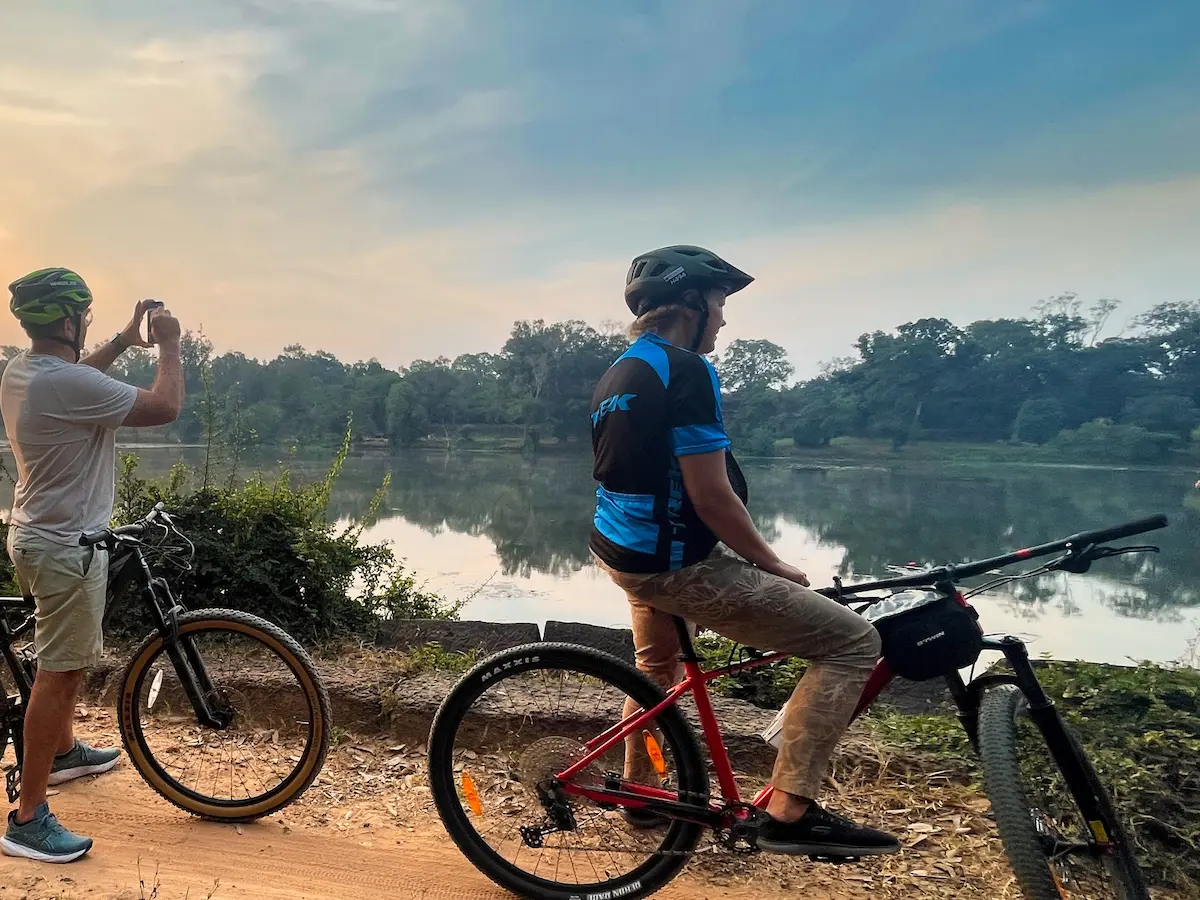
Both make excellent day trips with a three-day pass. For more off-the-beaten-path options, explore cycling Angkor Wat or try an e-bike tour at Angkor.
Opening Hours
The Angkor Archaeological Park is open from 5:00 AM to 6:30 PM daily. Most temples within the park open at 6:00 AM and close at 6:30 PM. These are the current official hours, which differ from the reduced COVID-era schedule still shown on many websites. The ticket office opens at 5:00 AM. If you buy your pass after 5:00 PM the day before, you get a free sunset entry that evening, and your pass days start the next morning.
What to Bring
- Water: At least 2 liters per person. Refill stations are rare inside the park.
- Sunscreen and hat: There is almost no shade between temples.
- Comfortable shoes: You’ll walk 10-15 kilometers on an average temple day.
- Small towel: For sweat. Honest answer: it’s hot.
- Cash: Small vendors inside the park don’t take cards. Bring US dollars in small bills.
- Flashlight or phone light: Some inner galleries are very dark.
- Patience: The temples have been here for 900 years. You don’t need to rush.
What Scams Should You Watch Out For at Angkor?
Most visitors have a trouble-free experience, but scams do exist. After years of running tours here, I’ve seen every trick. Knowing what to expect helps you avoid frustration and keep your focus on the temples, not on confrontations.
Fake Monks
Real monks at Angkor do not approach tourists asking for money. If someone in orange robes asks you for a “donation” or offers to bless you for cash, they’re not a legitimate monk. Politely decline and walk away. Genuine monks may be happy to talk if you approach them respectfully, but they won’t solicit money.
Extra Gate Fees
Your Angkor pass covers entry to every temple within the park. Nobody should charge you an additional fee at any temple entrance. If someone in an unofficial-looking uniform asks for extra money at a gate, it’s a scam. Show your pass and keep walking.
Fake Police
Occasionally, people dressed as police or park officials will claim you’ve broken a rule and demand an on-the-spot fine. Real park authorities wear official Apsara Authority uniforms with ID badges. If you’re unsure, ask to see identification or say you’ll report to the main ticket office. Real officers won’t object to this.
Children Vendors
Children selling postcards, bracelets, and cold drinks are common around the temples. They’re charming and persistent. Buying from them is a personal choice, but be aware that purchasing encourages families to keep children out of school. If you want to help, consider donating to established local education charities instead.
Monkeys
Macaque troops live around several temples, especially Bayon and the South Gate of Angkor Thom. They’re entertaining to watch but will grab food, water bottles, sunglasses, and anything shiny. Keep belongings secure. Don’t feed them. A macaque with a stolen camera is fast and completely indifferent to your feelings about it.
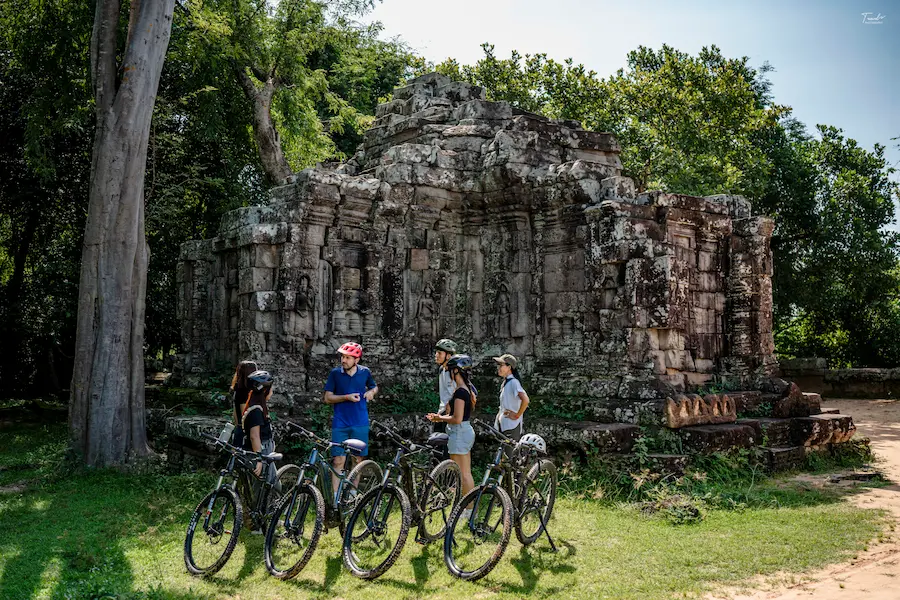
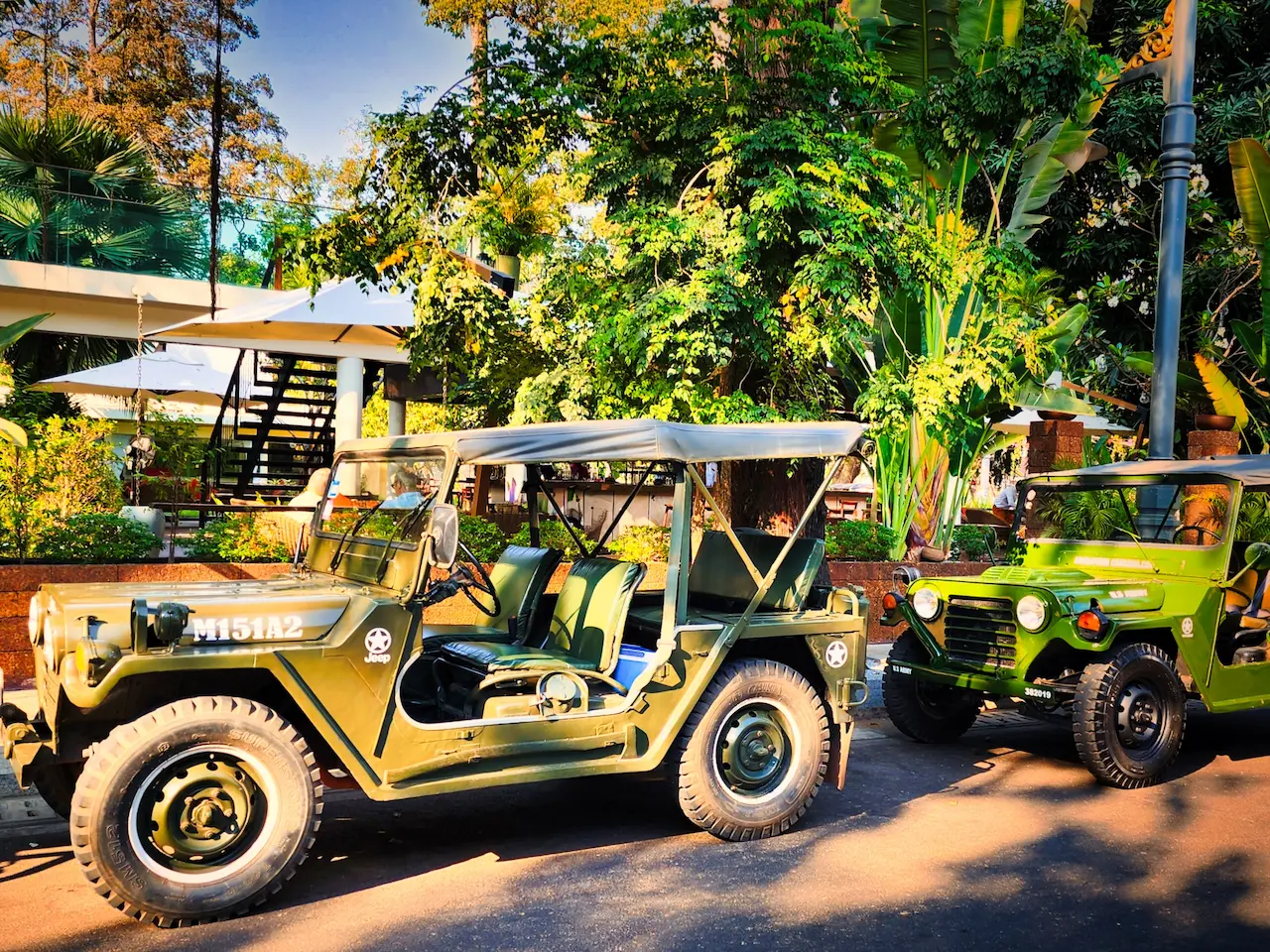
E-mountain biking along Angkor Thom’s ancient walls.
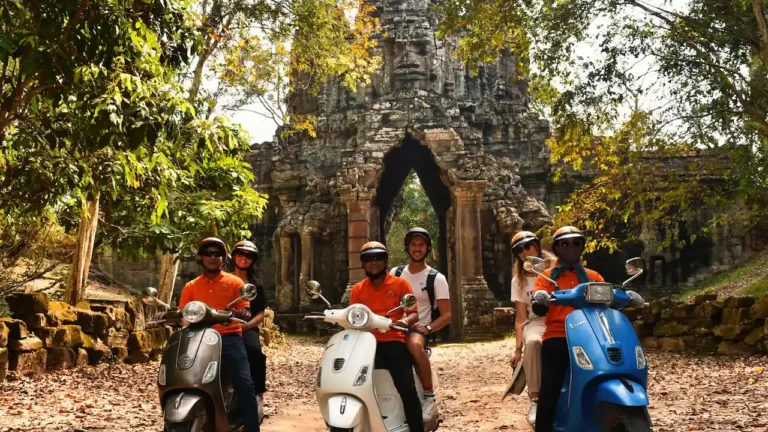
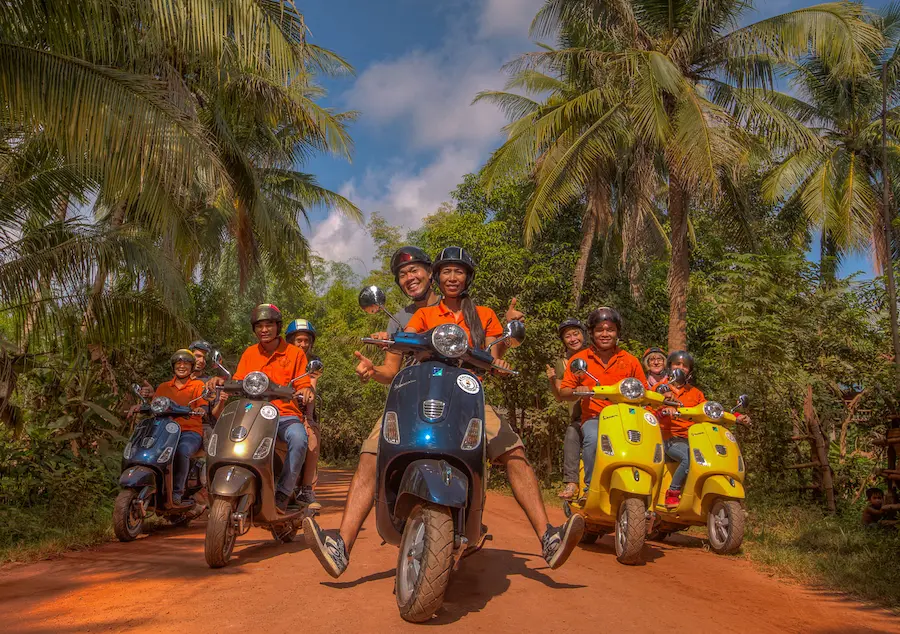
Our Vespa tours through the temple complex.
How Do You Get to Angkor from Siem Reap?
Angkor Wat is just 6 kilometers north of central Siem Reap, about 15-20 minutes by tuk-tuk. Most visitors hire a tuk-tuk driver for the day ($15-20 USD), which gives you flexibility to move between temples at your own pace. Private cars with air conditioning cost $30-45 per day.
Driver vs Guide
A driver takes you from temple to temple. A guide walks with you through each temple, explaining the history, pointing out details you’d miss, and answering questions. The difference is enormous. I’ve watched guests walk through Bayon in 15 minutes with a driver and spend 90 minutes there with a guide, seeing completely different things.
A licensed English-speaking guide costs $40-60 per day for a small group. It’s the single best investment you can make at Angkor. No engine can give you the silence of the Angkor forest, and no audioguide can answer the question you didn’t know you had.
Getting to Siem Reap: The New Airport
The new Siem Reap Angkor International Airport (SAI) opened in 2023, with capacity for 7 million passengers per year (siemreap.net). It sits about 45-60 minutes from the city center by car. Direct flights connect Siem Reap to Bangkok, Kuala Lumpur, Singapore, Ho Chi Minh City, and several Chinese cities.
Airport shuttle buses run to central Siem Reap. Private transfers are also available and worth the extra cost if you’re arriving tired. Check our Siem Reap travel guide for more arrival logistics.
Where Should You Stay When Visiting Angkor?
Stay in central Siem Reap, within 5-10 minutes of the temple entrance. There’s no accommodation inside the park itself. Siem Reap offers everything from $15 guesthouses to $1500-per-night luxury resorts, all within easy tuk-tuk distance of Angkor.
International Luxury
Zannier Phum Baitang, FCC by Avany, and Raffles Grand Hotel d’Angkor are the top international options. They offer pool, spa, and refined dining. All sit within 10 minutes of the temple entrance by car. Expect to pay $300-1000+ per night depending on season.
Cambodian Boutique
For something with more local character, boutique hotels like Jaya House River Park Hotel, Shinta Mani, and Sala Lodges blend Khmer design with modern comfort. Prices range from $80-200 per night. These properties support local employment and often source food from nearby farms.
Whichever you choose, make sure your hotel can arrange early morning transport for an angkor sunrise. Most can. And when you’re not at the temples, explore the best Cambodian food in Siem Reap’s restaurant scene, or plan a Battambang day trip.
Frequently Asked Questions
How early should I arrive for sunrise at Angkor Wat?
Arrive at the temple entrance by 5:00 AM. Gates open at 5:00 AM and the sunrise crowd builds quickly. Skip the reflecting pool and walk inside the temple for a more peaceful experience with far fewer people.
Is Angkor Wat worth visiting?
Absolutely. Angkor Wat is the world’s largest religious monument at 162.6 hectares (UNESCO). No photograph prepares you for the scale. Even travelers who have visited dozens of countries consistently rank it among the most extraordinary places they’ve seen.
Can I visit Angkor Wat on my own without a guide?
Yes. The temples are open to independent visitors with a valid Angkor pass. However, without a guide you’ll miss most of the story behind the carvings, the architectural details, and the cultural context. A guide transforms the visit from sightseeing into understanding.
What is the best temple at Angkor besides Angkor Wat?
Bayon, with its 216 stone faces, is the most visually striking. Ta Prohm, with trees growing through its walls, is the most atmospheric. Preah Khan is my personal favorite for its quiet grandeur. Each offers a completely different experience.
How much does a guide cost at Angkor?
A licensed English-speaking guide costs $40-60 per day for a small group (2-4 people). French, Japanese, and other language guides may cost slightly more. This is separate from your tuk-tuk or car hire, which runs $15-45 per day depending on vehicle type.
Is the Angkor pass valid for consecutive days only?
The one-day pass must be used on a single day. The three-day pass can be used on any three days within a 10-day period. The seven-day pass can be used on any seven days within a one-month period. This flexibility is one reason the three-day pass is the best value.
Are drones allowed at Angkor?
No. Drones are prohibited throughout the Angkor Archaeological Park. Violators face fines and equipment confiscation. This rule is strictly enforced. Use your camera from the ground instead.
Can I bring food and drinks into the temples?
Yes. Bring water and snacks. There are food stalls and small restaurants near the major temples, but options are limited and prices are slightly higher than in Siem Reap. Pack at least 2 liters of water per person.
Can I visit Angkor Wat during the rainy season?
Yes, and it can be wonderful. Rain typically falls in afternoon bursts lasting one to two hours, with clear mornings. The moats fill completely, creating the best reflection photographs. Green season (June-October) also means fewer crowds. January rainfall averages just 10 millimeters, while September sees roughly 286 millimeters (Climate-Data.org).
Is Angkor Wat accessible for visitors with mobility issues?
The ground level of Angkor Wat is mostly flat and wheelchair-accessible along the main corridors. However, the upper level (Bakan) requires climbing very steep stairs and is not accessible. Bayon, Ta Prohm, and Preah Khan involve uneven terrain with tree roots and broken stone. The Terrace of the Elephants and Angkor Wat’s outer galleries are the most accessible areas in the park.