
September 20, 2026
Updated July 2026.
Is Siem Reap safe in 2026? Yes. Siem Reap and Angkor are open, calm, and operating normally. The Thailand border tension you may have read about is 250 kilometers away and does not touch daily life here.
The short version
- The short answer: Yes. Siem Reap is open and operating normally. The US State Department rates Cambodia Level 2, the same as France or Germany.
- Thailand border: The tension sits in a 30 km strip around Preah Vihear, 250 km away. Fly into Siem Reap (SAI) or Phnom Penh (PNH) instead of crossing overland at Poipet.
- Biggest real risk: Road accidents. Don’t rent a scooter; most travel insurance voids coverage without a motorcycle license. Tuk-tuks via Grab run $2-6 per ride.
- Tap water: Don’t drink it. Bottled or filtered only, roughly $0.50 per 1.5-liter bottle. Brush your teeth with bottled water too.
- Emergency numbers: 117 or 118 for Tourist Police (they speak English), 119 for ambulance. Save them to your phone before arrival.
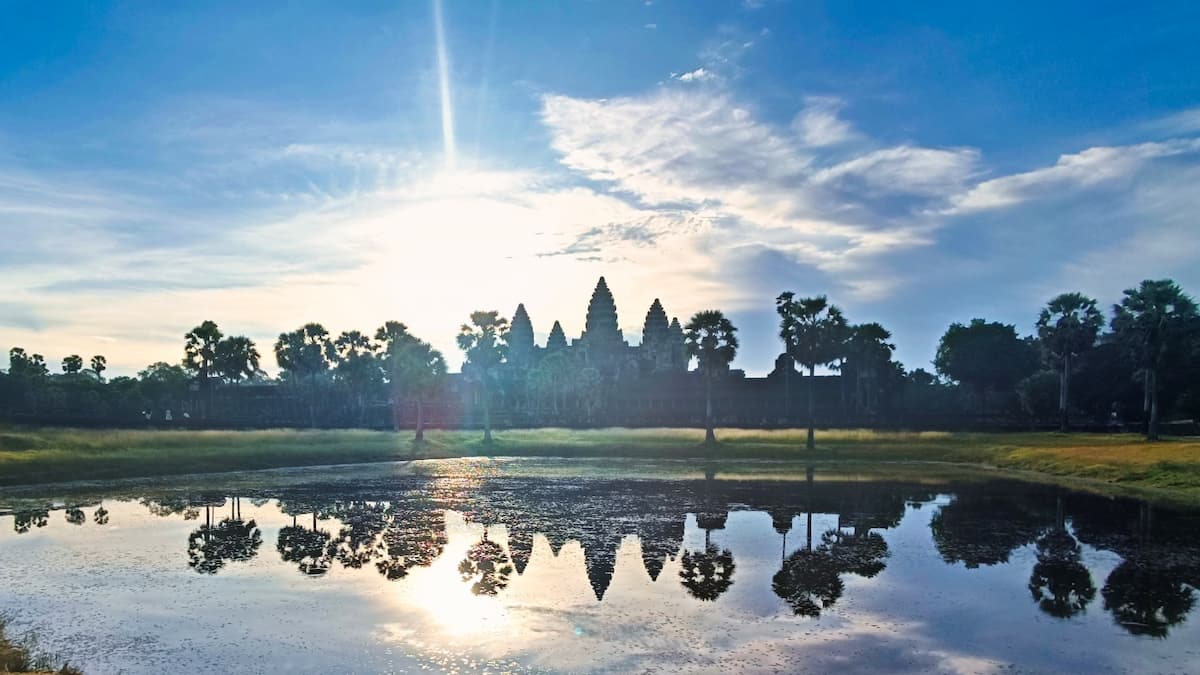
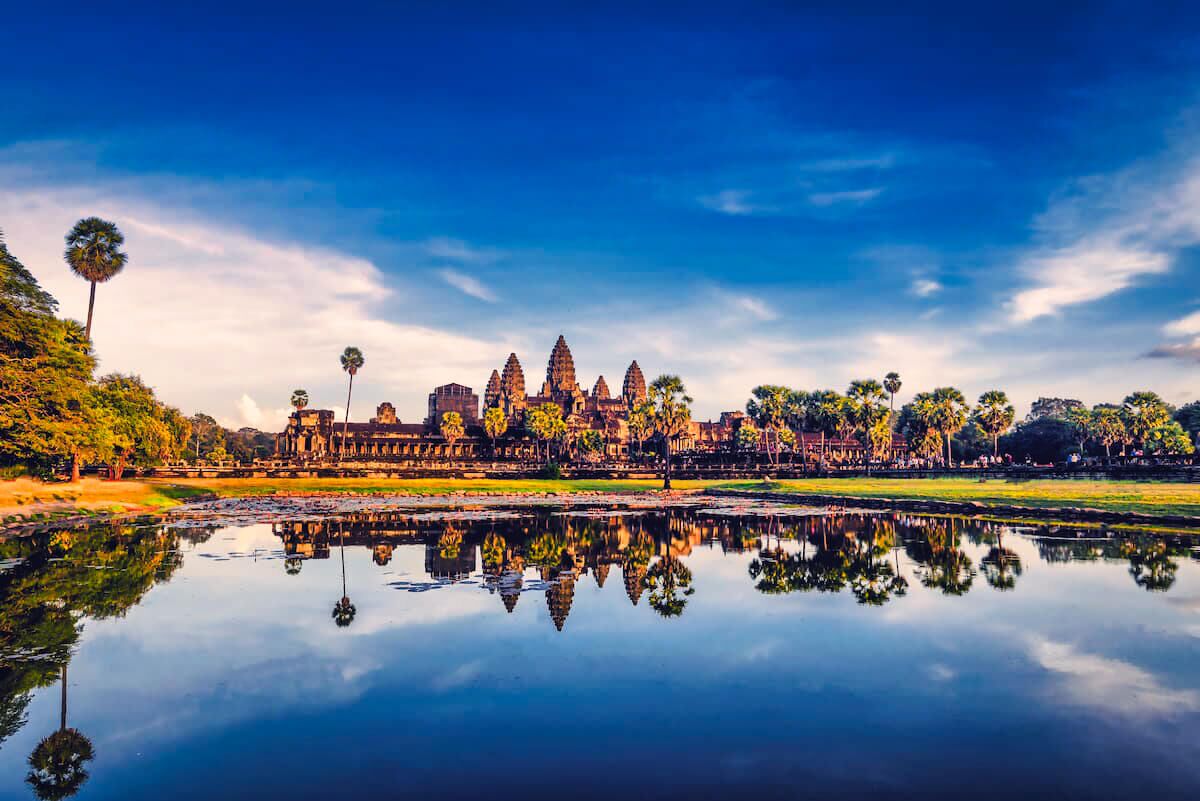
Sunrise at Angkor Wat’s reflecting pool.
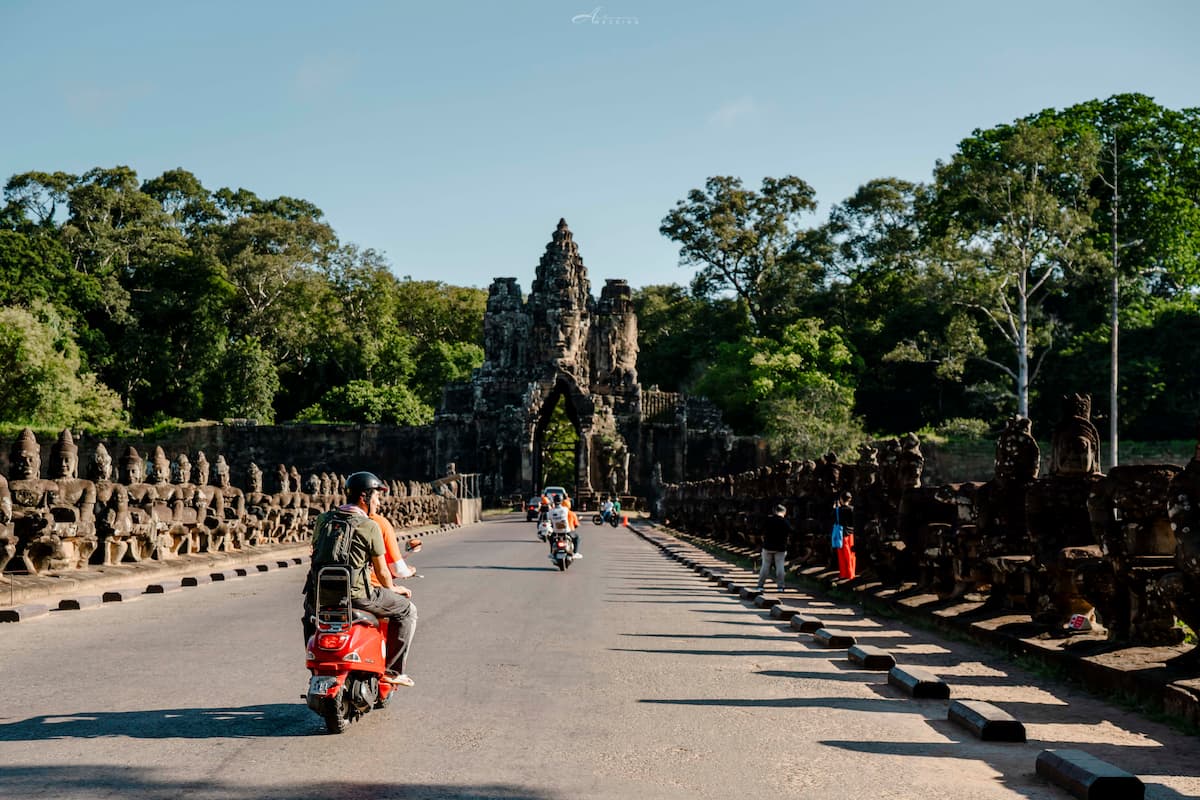
The iconic face towers at Angkor Thom’s south gate.
I was raised inside Angkor Wat. I’ve lived in Siem Reap for more than forty years, and I still walk home from the night market alone past midnight. So when a guest asks me if it’s safe, I’m not reading them a government advisory. I’m telling them about my own street.
So what should you actually watch for? Honestly, not the border. That tension sits 250 kilometers away, and Siem Reap runs completely normally. Crime? Mostly petty theft, the kind you’d guard against in any city. The real risks here are the tap water and the roads, and both are simple to manage once you know how. Everything below is what I tell my own guests, checked against the US State Department and UK FCDO travel advisories and WHO health guidance. No sugar-coating, no fear-mongering.
Is Siem Reap Safe Right Now?
Yes. Siem Reap is safe right now. The city received over 955,000 foreign visitors to the Angkor park in 2025, and in 1 out of 4 Adventures Cambodia guest reviews the phrase “felt safe” appears unprompted. Temples are operating normally, police presence is visible, and the city center feels calmer than most American downtowns after dark.
I live here. My staff live here. Our guests arrive every week from the US, UK, Australia, and France. The question I get most before arrival, “is it actually safe right now?”, almost always becomes, “why were we worried?” within 24 hours of landing. Pub Street at 10 PM is a friendly, lit, policed tourist zone, not a risk zone.
Fly direct into Siem Reap
Fly directly into Siem Reap Angkor International Airport (SAI), 40 km southeast of town. Direct arrival means you skip the overland border issue entirely. Bangkok, Singapore, Kuala Lumpur, Ho Chi Minh City, and several Chinese cities all connect daily. This is the single simplest “am I safe” decision you can make.
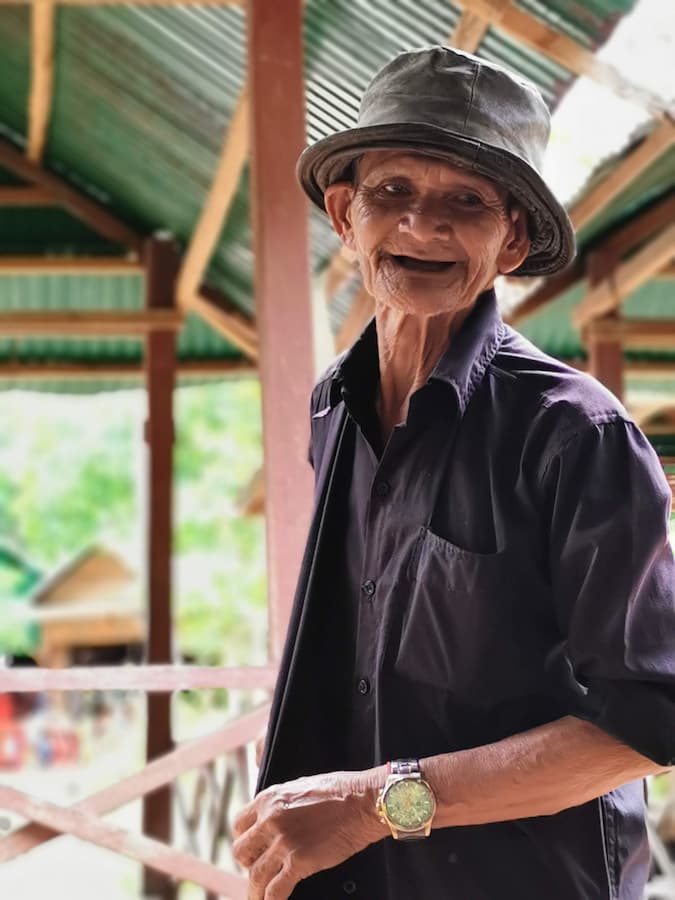
Elder at Phnom Kulen.
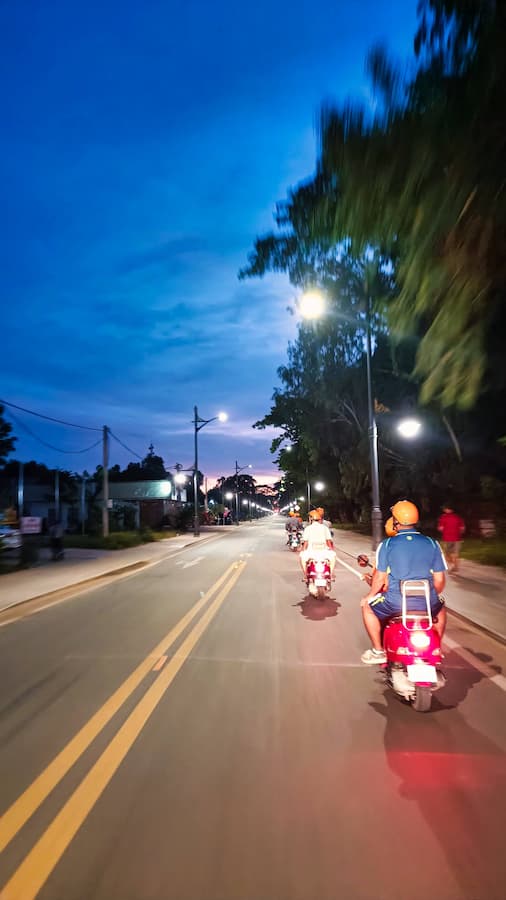
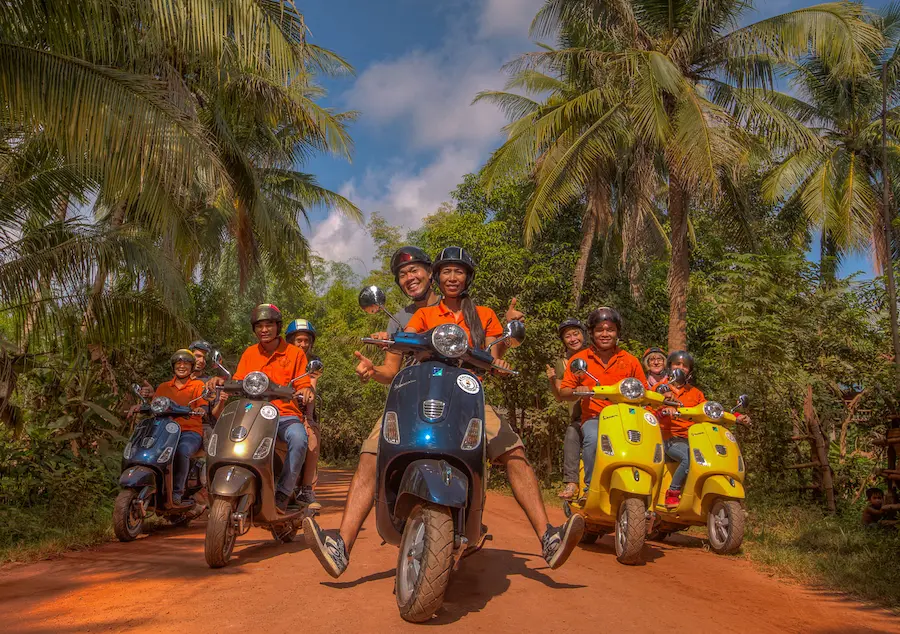
Vespa convoy before sunrise at Angkor Wat.
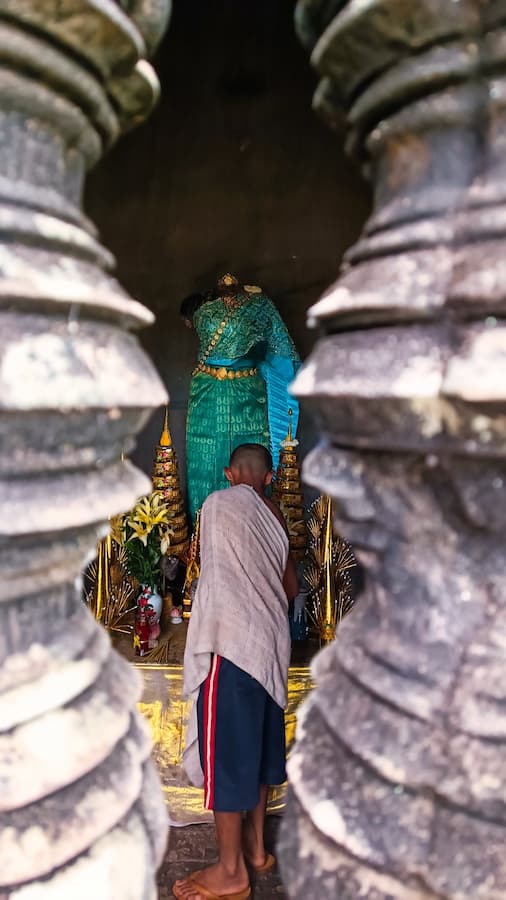
Worshipper at the Vishnu shrine, Angkor Wat.
Is Cambodia Safe in 2026? The Country-Level Answer
Cambodia sits at Level 2, “Exercise Increased Caution,” on the US State Department advisory scale. For context, France, Italy, the UK, and Germany sit at the same level. The UK’s FCDO advises normal travel to most of the country, with specific caveats only near the Thai border.
In plain language: Cambodia is not a war zone, not an outbreak zone, and not under civil unrest. The advisories flag petty crime, road safety, and a narrow border strip. They do not flag Siem Reap, Phnom Penh, or the coast. Most travelers who read the State Department page in full come away reassured, not alarmed.
In 12+ years of running Adventures Cambodia, we’ve hosted thousands of guests. The number who have experienced violent crime: zero. The number who have dealt with a minor scam or lost item: a handful. That ratio matches what I’d expect in any mid-sized Asian city.
The Thailand-Cambodia Border: What Travelers Need to Know
Tensions along a specific 30-kilometer stretch of the Thai-Cambodian border made international news in 2025. That stretch is around Preah Vihear and Oddar Meanchey provinces, 250 kilometers north of Siem Reap. Siem Reap city and the entire Angkor park are unaffected. Daily life, temple operations, and tourism continue normally.
The practical issue is overland crossings. Both the US State Department and UK FCDO currently advise against non-essential travel to a narrow strip along the shared border. This affects the Poipet land crossing from Thailand, not your trip if you fly in.
AVOID OVERLAND FROM THAILAND RIGHT NOW
Skip the Poipet land border in 2026. Fly directly into Siem Reap (SAI) or Phnom Penh (PNH) instead. Direct flights from Bangkok are roughly $80-150 and take one hour.
What Petty Crime and Scams Happen in Siem Reap?
Petty crime is the only safety category that matters for 99% of Siem Reap visitors — and even that is quieter here than almost anywhere else in Southeast Asia. The US State Department lists bag-snatching and market pickpocketing as common incidents country-wide, but those are primarily a Phnom Penh concern. In Siem Reap, I have not seen either in the neighborhoods travelers actually visit. What does happen here is overcharging — and it is rarely serious.
| Scam | In short | Detail |
|---|---|---|
| TUK-TUK OVERCHARGE | Agree price first | Or use Grab for a metered fare. Normal range: $2-6. |
| ATM FEE TRAP | Decline conversion | Machines push a bad exchange rate (DCC). Always “decline conversion” — let your bank convert. |
| FAKE MONKS | Donation scam | Real monks do not approach tourists asking for cash. Politely decline. |
| SCOOTER RENTAL | Skip it entirely | Foreign riders get flagged for minor infractions. Use a tuk-tuk or private driver instead. |
The single most common Siem Reap “incident” for tourists isn’t theft — it’s ATM overcharge confusion. Travelers accept the machine’s offered exchange rate (bad) instead of declining it (good). See our Cambodia currency guide for the specific button sequence that saves 8-12% per withdrawal.
How Safe Is Traffic and Road Travel in Siem Reap?
Road accidents are statistically the single biggest injury risk for travelers in Cambodia, flagged explicitly by the CDC. Cambodian roads mix scooters, tuk-tuks, cows, and trucks at different speeds. The fix is simple: don’t drive yourself. Let someone who rides these streets every day handle the traffic.
Don’t Rent a Scooter
Scooter rentals look cheap and fun. They are the #1 reason tourists end up in Siem Reap’s hospitals. Most travel insurance policies also void coverage if you ride without a valid motorcycle license, which very few visitors have. The math is bad. Just take a tuk-tuk.
Use Grab
Grab is the ride-hailing app we recommend in Siem Reap. It gives you a metered fare, a tracked route, and a driver rating — no haggling, no surprises. A typical ride inside town costs $2-4. To the airport it’s roughly $12-15. Download before you fly: Apple App Store or Google Play.
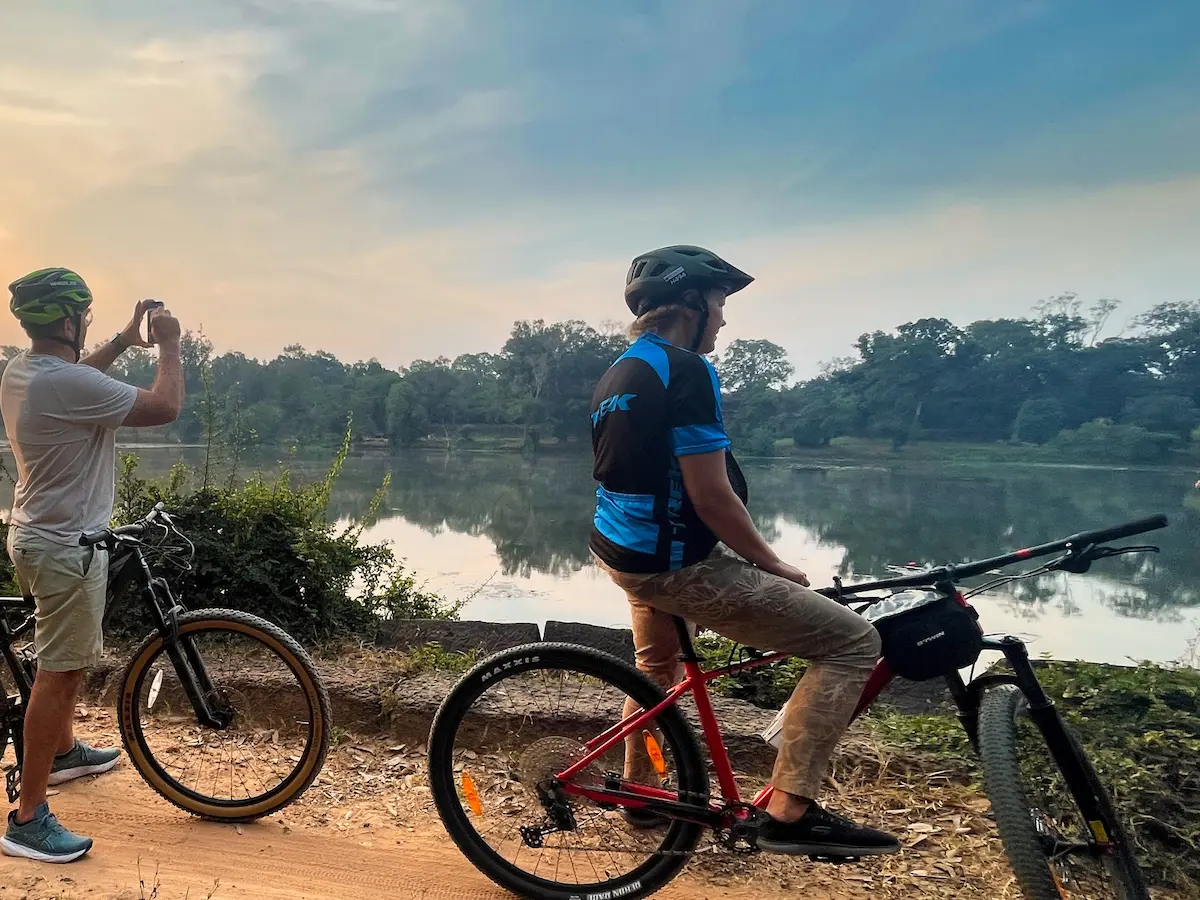
For temple days, book a private driver-plus-guide rather than negotiating tuk-tuks at dawn. For exploring the countryside safely, an e-MTB experience runs you through the villages on quiet back trails, with a guide who knows every shortcut. Both remove the road-safety variable entirely.
Travel Insurance: What Your Policy Must Cover
A $50 tuk-tuk scam is annoying. A $50,000 medevac to Bangkok is ruinous. Cambodia has excellent clinics for minor issues, but serious trauma or surgery means evacuation by air — and that is where most traveler regret is born. Before you fly, confirm your policy covers these four items specifically.
| Cover | What to look for | Why |
|---|---|---|
| MEDICAL EVAC | $100K minimum | Covers the flight to Bangkok if a local hospital can’t treat your condition. |
| SCOOTER CLAUSE | Read the fine print | Most policies void coverage without a valid motorcycle license. Safer not to ride. |
| DENGUE / HOSPITAL | Inpatient days | Severe dengue can mean a 3-5 day hospital stay. Confirm your policy’s daily cap. |
| TRIP CANCELLATION | Border / weather | Covers non-refundable costs if a flight, border, or storm disrupts your trip. |
Buy the policy the same day you book your flights. Most insurers cover pre-existing conditions only if you purchase within 14-21 days of your initial trip deposit — wait longer and that coverage disappears.
Can You Drink the Water in Cambodia?
No. Do not drink the tap water in Cambodia. The CDC rates Cambodian tap water as not safe for travelers, and the WHO confirms municipal treatment is inconsistent outside major hotels. Stick to bottled or filtered water. A 1.5-liter bottle costs about 2,000 riel (~$0.50) at any shop.
| Water or Food Item | Safe? | Notes |
|---|---|---|
| Tap water (drinking) | No | Use bottled or filtered. |
| Brushing teeth with tap water | Use bottled | Small risk, but the upside of using bottled is zero cost. |
| Ice in restaurants | Generally yes | Commercial ice (cylinder with hole) is factory-made and safe. |
| Fresh fruit & salad | At reputable spots, yes | Good hotels and restaurants wash produce with filtered water. |
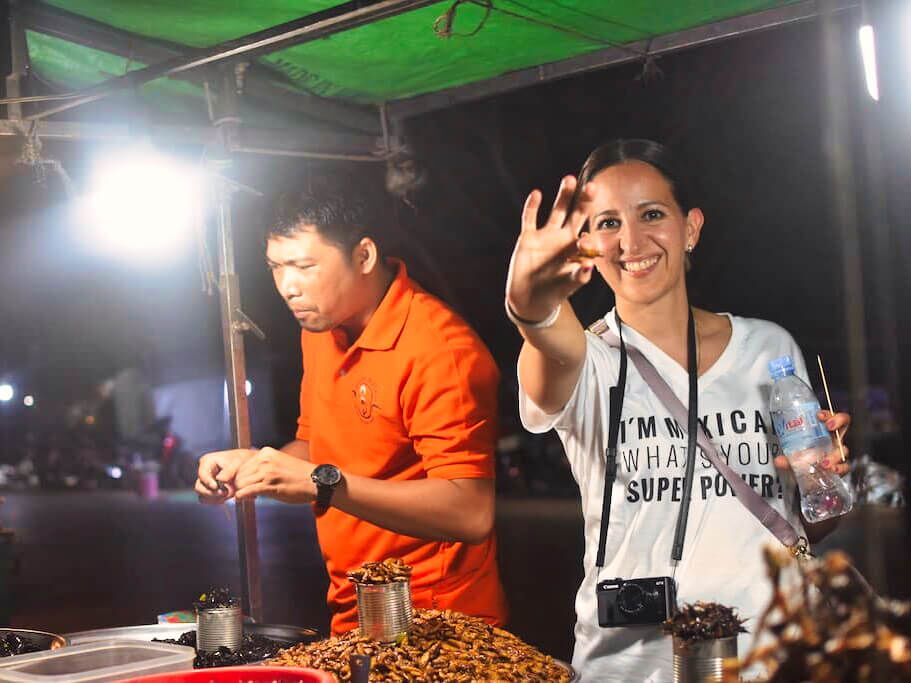
| Street food | Yes, if hot & busy | High turnover = fresh. Look for crowded local stalls. |
| Tap water in the shower | Yes | Just don’t swallow it. |
Guidance based on CDC Cambodia Traveler Health and WHO Cambodia.
Street food gets a bad reputation it doesn’t deserve. The CDC rule is simple: hot, fresh, and busy. A stall with a long local line turns over its ingredients every hour. That’s often safer than a quiet tourist restaurant with food sitting under a heat lamp.
Health: Mosquitoes, Dengue, and What to Pack
Dengue fever is endemic in Cambodia, with a seasonal peak from May to October during the wet season, per the WHO. There is no malaria risk in Siem Reap city itself, according to the CDC. The practical defense is simple: use DEET-based repellent at dawn and dusk, and wear long sleeves in the evening.
What to Pack
- DEET 30% repellent — the mosquito-borne disease standard per CDC.
- Oral rehydration salts — cheap, small, a lifesaver if you catch a stomach bug.
- Basic first-aid kit — plasters, antiseptic wipes, painkillers.
- Sunscreen SPF 50+ — Cambodia is 13° north of the equator.
- Travel insurance card — with emergency evacuation coverage.
Routine vaccinations (tetanus, MMR, hepatitis A) should be up to date. Typhoid and hepatitis B are recommended for most travelers. Rabies pre-exposure shots are worth it only for very long trips or specific professions. Check with your doctor 4-6 weeks before travel.
Is Siem Reap Safe for Women Travelers?
Yes. Siem Reap is one of the easier cities in Southeast Asia for women to travel solo or in pairs. Serious gender-based crime against tourists is rare, and the cultural tone is conservative-but-welcoming rather than aggressive. That said, the standard big-city common sense still applies, especially at night. If you’re travelling solo, read our full guide to solo female travel in Cambodia for the practical detail this section cannot fully cover.
I’m a Cambodian woman. I’ve lived in Siem Reap my entire adult life. I walk home from the office past 11 PM most nights. I eat dinner alone at restaurants, ride in tuk-tuks alone, and cross Pub Street alone. This isn’t bravery on my part, it’s just the normal lived reality of the city I know best.
Practical Tips for Women
- Dress code at temples: shoulders and knees covered. Guards enforce it at Angkor Wat’s upper level.
- Dining solo: completely normal. No one will look twice.
- Night travel: use Grab after dark rather than walking alone on unlit side streets.
- Pub Street: fine alone, even late. Busy, lit, policed.
- Catcalling: rare. Cambodian culture is understated; you’ll experience less street attention than in Italy or India.
Many women travelers choose a private guide for exactly this reason. Our premium and private tours mean your own guide, your own vehicle and a plan that is yours to change.
Is Siem Reap Safe for Families with Kids?
Yes — Siem Reap is one of the calmer family-travel cities in Southeast Asia. Cambodian culture genuinely adores children, and you’ll notice hotel staff, drivers, and temple attendants go out of their way to make kids welcome. Children under 12 enter the Angkor park free with their passport, confirmed by Angkor Enterprise. The practical watch-outs are heat and stomachs, not hazards.
| Risk | In short | What to do |
|---|---|---|
| HEAT & HYDRATION | The real risk | Temples by 6 AM, back by 10 AM. Afternoons = pool, museum, or siesta. |
| STOMACH UPSETS | Ease in slowly | Kids tolerate Khmer food well. Skip ice and salads for the first two days. |
| MOSQUITO COVER | DEET or picaridin | Dusk is peak. Long sleeves and repellent for outdoor dinners. |
| ROAD SAFETY | Car seats are rare | Bring your own for toddlers. A private car beats a tuk-tuk for infants. |
Families regularly bring children as young as four on our private experiences. The honest limiter isn’t safety — it’s temple fatigue. Three days is a comfortable Angkor trip with kids. Five days starts to test everyone. If you’re still working out the length of the trip, here’s how many days you need in Siem Reap.
Are Angkor and Remote Areas Safe? (Landmines in Context)
The Angkor Archaeological Park is fully cleared of landmines and has been for decades, confirmed by Angkor Enterprise. Every trail you’ll walk, every temple you’ll visit, and the entire perimeter is safe. The landmine legacy is real in Cambodia’s remote northwest, but not where tourists go.
If you want to understand the demining story, visit the APOPO Visitor Center just outside Siem Reap. Their HeroRATs are giant African pouched rats trained to sniff explosives, and they’ve helped clear millions of square meters of land across Cambodia. It’s one of the most surprisingly moving hours you can spend here.
RURAL AREAS: STAY ON MARKED PATHS
If you venture into far-rural provinces like Pailin or parts of Oddar Meanchey, never stray off marked paths. The risk is low but non-zero in a small handful of specific districts. This does not apply to Siem Reap, Angkor, Phnom Penh, Battambang, or any standard tourist route.
The tourist circuits at Angkor are cleared, mapped and visited by thousands of people every day. If you want the context read to you as you go, our private Angkor tours stay on the routes our guides ride all year.
ATMs, Cash, and Money Safety
Cambodia runs on US dollars for anything above $1, and on riel for change. ATMs are widespread in Siem Reap and generally safe when attached to banks. Skip stand-alone ATMs inside convenience stores when possible. For a full breakdown of bills, riel/dollar mix, and ATM fees, see our Cambodia currency guide.
ATM Best Practices
- Use bank-branch ATMs (ABA, ACLEDA, Canadia) during daylight.
- Decline the machine’s exchange rate when offered, always.
- Bring two cards on different networks in case one is blocked.
- Check bills for tears; torn USD notes are often refused by shops.
- Keep smaller bills — $100 USD bills are hard to break outside hotels.
What to Do If Something Goes Wrong
If something does go wrong, the response system in Siem Reap is straightforward. The Tourist Police are specifically trained to help foreign visitors, English-speaking clinics exist, and your embassy in Phnom Penh is two hours away by road or one hour by flight. Save the key numbers below to your phone before you fly.
| Service | Contact | Notes |
|---|---|---|
| TOURIST POLICE | 117 / 118 | English-speaking. Primary contact for any incident. |
| AMBULANCE | 119 | Or go direct to Royal Angkor International Hospital. |
| HOSPITAL | Royal Angkor Intl | 24/7, English-speaking, accepts international insurance. |
| EMBASSY | Phnom Penh | US, UK, AU, FR all based in the capital. Register before arrival. |
For lost passports, your embassy issues an emergency travel document within 1-3 business days. For a medical issue that needs evacuation, travel insurance with evacuation coverage lifts you to Bangkok in under two hours. This is why insurance matters: not for the $50 claim, but for the $50,000 one.
Embassy Contacts in Cambodia (All in Phnom Penh)
Save your embassy’s after-hours emergency line to your phone before you fly. If you lose your passport or face a serious incident, that number is your first call.
| Country | Main line | Official website |
|---|---|---|
| United States | +855 23 728 000 | kh.usembassy.gov |
| United Kingdom | +855 23 427 124 | gov.uk/world/cambodia |
| Canada | +855 23 213 470 | international.gc.ca |
| Australia | +855 23 213 470 | cambodia.embassy.gov.au |
| France | +855 23 430 020 | kh.ambafrance.org |
| Germany | +855 23 216 381 | phnom-penh.diplo.de |
Numbers from each country's official embassy site — verify before travel.
Frequently Asked Questions
Is Siem Reap safe to visit in 2026?
Yes. Siem Reap is open, operating normally, and 250 km from the Thai border tension zone. The US State Department rates Cambodia at Level 2, the same as France or Germany. Standard big-city caution applies for petty theft, but serious crime against tourists is rare.
Is Cambodia safe right now given the Thailand border issue?
Yes, with one caveat. The border tension affects a 30 km strip around Preah Vihear, not the country at large. Siem Reap, Phnom Penh, and Battambang are unaffected. Fly into Siem Reap (SAI) or Phnom Penh (PNH) rather than crossing overland from Thailand at Poipet.
Can you drink the tap water in Cambodia?
No. Do not drink tap water in Cambodia. The CDC rates it as unsafe for travelers. Use bottled or filtered water, which costs roughly $0.50 per 1.5-liter bottle. Good restaurants wash produce with filtered water, so salads and fruit are generally fine.
Can you brush your teeth with tap water in Cambodia?
Technically the risk is small, but I recommend using bottled water for brushing teeth anyway. Hotels leave a free bottle in the bathroom for this reason. It’s a zero-cost habit that removes one of the most common sources of traveler stomach bugs in Southeast Asia.
Is Siem Reap safe for women traveling alone?
Yes. Siem Reap is one of the easier Southeast Asian cities for solo women. Serious gender-based crime against tourists is rare, catcalling is uncommon, and dining alone is culturally normal. Use Grab rather than walking alone on unlit side streets after dark.
Are there landmines at Angkor Wat?
No. The entire Angkor Archaeological Park has been demined for decades, confirmed by Angkor Enterprise. Every trail and temple perimeter is safe. The landmine legacy exists in remote northwest provinces like Pailin, not where tourists travel.
What’s the biggest real safety risk in Siem Reap?
Road accidents, specifically scooter rentals. The CDC flags road travel as the top injury risk in Cambodia. Don’t rent a scooter; most travel insurance voids coverage without a motorcycle license. Use tuk-tuks via Grab for roughly $2-6 per ride.
Do I need vaccines for Cambodia?
Routine vaccines (tetanus, MMR, hepatitis A) should be current. Typhoid and hepatitis B are recommended by the CDC for most travelers. There’s no malaria risk in Siem Reap city. Check with a travel-medicine doctor 4-6 weeks before your trip.
What’s the emergency number in Cambodia?
Dial 117 or 118 for Tourist Police, 119 for ambulance. Tourist Police officers speak English and are the primary contact for visitors. Royal Angkor International Hospital in Siem Reap is open 24/7 and accepts international insurance. Save these numbers to your phone before arrival.