
September 20, 2026
Updated July 2026.
I grew up inside Angkor Wat. As a child, I rode a battered Chinese bicycle between the temples before tourism existed here. The moat was my swimming pool. The causeways were my racing tracks. Forty years on, I watch thousands of travelers a year try to cycle the same routes, and most of them learn the hard way that Angkor is not a casual bike ride. The temples are scattered across 400 square kilometers. The heat sits at 33-36°C most afternoons. The navigation is unforgiving if you miss a turn.
This guide covers everything I wish every guest knew before choosing a bike. Yes, you can cycle Angkor. Yes, self-guided is an option. But if you want to actually enjoy the temples instead of just surviving the ride, there is a better way. At Adventures Cambodia we only run electric mountain bike tours, and after more than ten years of watching visitors succeed and struggle, I will tell you exactly why.
The short version
- Yes, you can cycle Angkor. The park is bike-friendly, temples are well spaced, and roads are sealed.
- Small Circuit: ~25 km inside the park, ~35 km round-trip from Siem Reap. Grand Circuit: ~30 km inside, ~45 km round-trip.
- Heat is the real challenge. 33-36°C by late morning (Climate-Data.org). Start at sunrise, finish by 11:00 AM.
- Tickets: $37 (1-day), $62 (3-day), $72 (7-day) from Angkor Enterprise. Buy online before the day.
- E-MTB beats regular bikes for most visitors. Pedal-assist cuts effort by 60-70% and lets you focus on the temples, not your thighs.
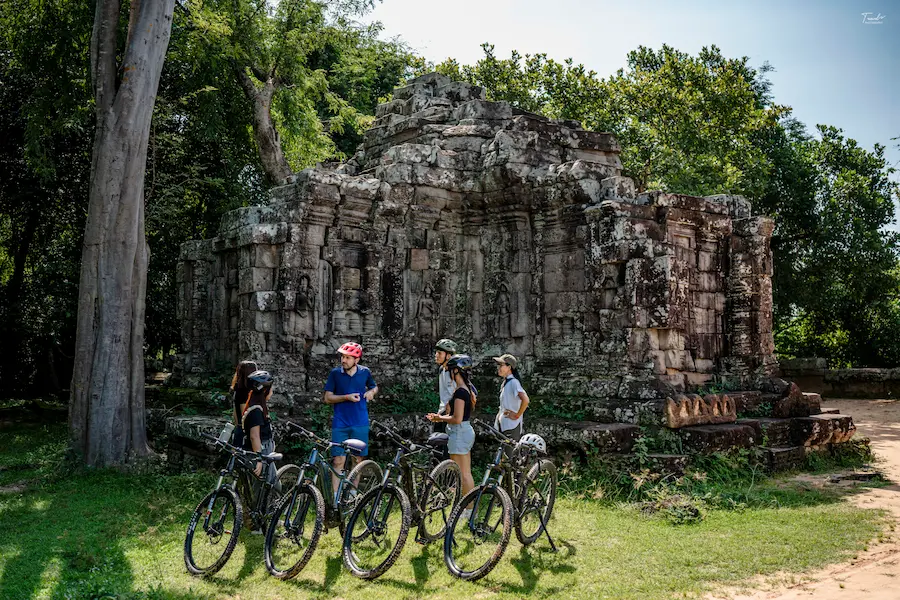
A forest trail along the ancient walls of Angkor Thom.
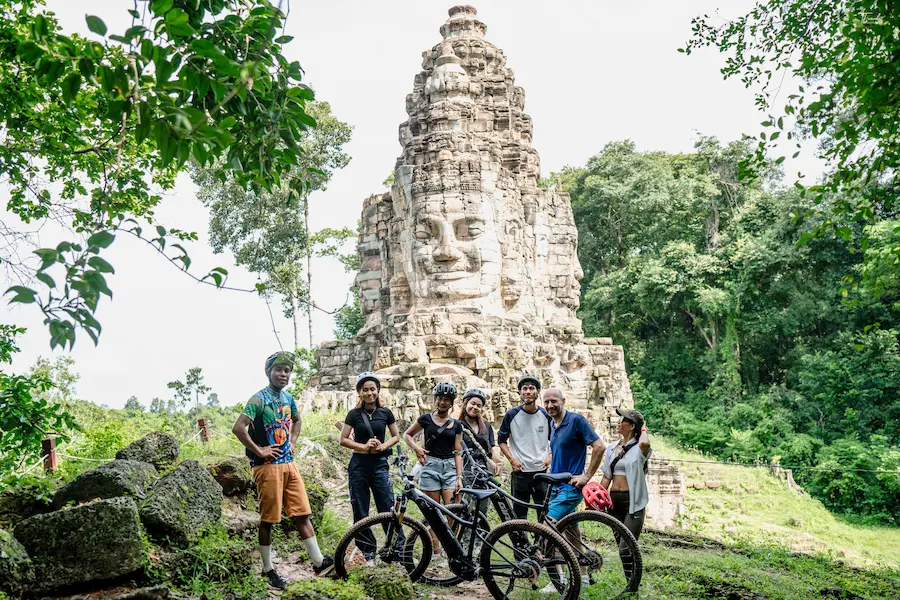
Ta Kav gate, a quiet entrance most cyclists miss.
Can You Actually Cycle at Angkor?
Yes, and thousands of travelers do every day. The Angkor Archaeological Park is one of the most cycle-friendly heritage sites in Southeast Asia. Roads are sealed, gradients are gentle, traffic inside the park is light, and the main circuits were designed for easy navigation between temples (UNESCO). Siem Reap sits just 6 kilometers south of the main entrance, so most cyclists ride in from their hotel and ride back at the end of the day.
One real caveat: Angkor is not a casual city cycle. The park covers more than 400 square kilometers. A full Small Circuit day is 30+ kilometers. The heat peaks above 36°C in March and April. And once you are deep in the forest between temples, there is no food stall, no shade, no one to help if a tire blows. Plan for that, or let someone plan for you.
Guided first, self-guided after
If this is your first time in Cambodia, cycle Angkor with a guide on day one. You cover more ground, miss fewer temples, and actually learn what you are looking at. Do a self-guided ride on day two or three once you know the layout. That is how I would do it if I were visiting, not living here.
The Two Circuits: What You’ll Actually See
Every cyclist at Angkor rides one of two routes: the Small Circuit or the Grand Circuit. They overlap at Angkor Wat and Angkor Thom, then diverge. Which one fits depends on your fitness, your time, and what you want to see.
| Route | Distance (in park) | Round-trip from Siem Reap | Temples | Time |
|---|---|---|---|---|
| Small Circuit | ~25 km | ~35 km | Angkor Wat, Angkor Thom, Bayon, Ta Prohm, Banteay Kdei | 6-8 hours |
| Grand Circuit | ~30 km | ~45 km | Preah Khan, Neak Pean, Ta Som, East Mebon, Pre Rup | 7-9 hours |
Source: Angkor Database + Adventures Cambodia field routing.
The Small Circuit
This is the classic one-day route and the one almost every first-time cyclist rides. You enter the park, ride past Angkor Wat’s western causeway, continue north to the south gate of Angkor Thom, enter the walled city, visit Bayon and the Terrace of the Elephants, exit through the victory gate east, roll down to Ta Prohm, then loop back past Banteay Kdei to Angkor Wat for a second visit on the way home. The full story of this route is in the Small Circuit itinerary guide.
The Grand Circuit
Longer, quieter, and my favorite for repeat visitors. The Grand Circuit picks up where the Small leaves off: from Angkor Thom you ride northeast to Preah Khan, then east to Neak Pean and Ta Som, south past East Mebon and Pre Rup, and back to Siem Reap. Fewer tour buses reach these temples. The forest feels older. Preah Khan alone deserves an hour.
Self-Guided or Guided: Which Is Right for You?
The biggest decision is not which bike to rent, but whether to ride alone or with a guide. I have watched both experiences play out thousands of times. They produce very different days.
Self-Guided: Rent a Bike in Town
Bike rental shops line Sivatha Road and Street 63 in Siem Reap. Expect $3-8 per day for a basic hybrid, $10-20 for a mountain bike with better gearing, $15-25 for an e-bike if the shop has one. You ride out, buy your pass at the main ticket office on Apsara Road, and navigate the circuits yourself. Simple enough in theory.
What tends to go wrong in practice: guests underestimate the heat and return exhausted by 10:00 AM with two temples seen; navigation mistakes add 5-10 kilometers; the cheap rental bike has a soft saddle and no proper gearing for the inclines around Phnom Bakheng; and without context, the carvings are just old stone. You still enjoy the day, but you miss most of what makes Angkor extraordinary.
Guided: Our Electric Mountain Bike Tours
At Adventures Cambodia we only offer electric mountain bike tours. No regular bike rentals, no standard bicycle day tours. This is deliberate. After more than a decade guiding visitors in this climate, we launched our e-MTB program with brand new top-range Giant Talon E+ bikes because they are the only machines that let most visitors enjoy the temples instead of endure them. Our guides know cycling and temple history equally well, and they know the forest trails most cyclists never find.
| EFFORT | Down 60-70% | Pedal-assist does the heavy work |
|---|---|---|
| SHADE ROUTES | Forest trails | Off the main circuit loop |
| GROUP SIZE | Private only | Never with strangers |
| AGE RANGE | 2 and up | Child seats and trail-a-bikes |
All E-bike ToursEvery ride we run
Countryside TourVillages and rice fields, no pass needed
Angkor 2 daysSmall + Grand Circuit, both by e-bike
Secret TrailsForest paths, monk blessing, Preah Khan
Grand CircuitThe remote temples, 1 day
Small CircuitAngkor Wat, Bayon & Ta Prohm
Angkor Wat SunriseBreakfast by the moat
Why E-MTB Works in This Heat
Cambodia is hot. Siem Reap sits at 33-36°C most of the year with humidity above 70% (Climate-Data.org). A 35-kilometer ride on a regular bike in that weather is a physical test, not a cultural visit. Guests who choose a regular bike almost always regret it by lunch.
The e-bikes we use have four pedal-assist levels. On the lowest setting you still work and break a sweat; on the highest, the motor handles every hill and headwind. Most guests cruise at level 2 all day, burn a comfortable amount of energy, and arrive at each temple ready to explore instead of recover. Read our deep dive on the e-MTB experience at Angkor for the full technical breakdown.
The moment guests understand why e-MTB matters is usually around kilometer 15, on the forest trail behind Preah Khan, when they are pedaling easily and realizing they still have energy for the afternoon. That is the ride you came for. Not the one where you are dragging yourself up the last hill back to the hotel.
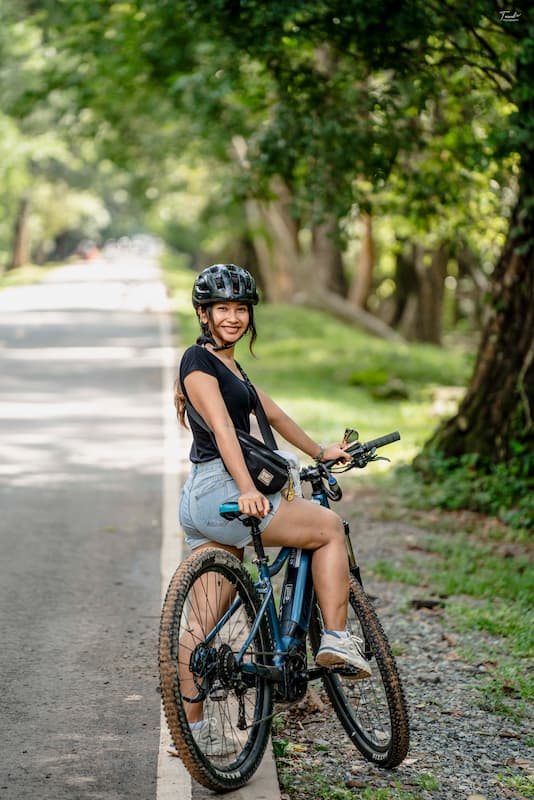
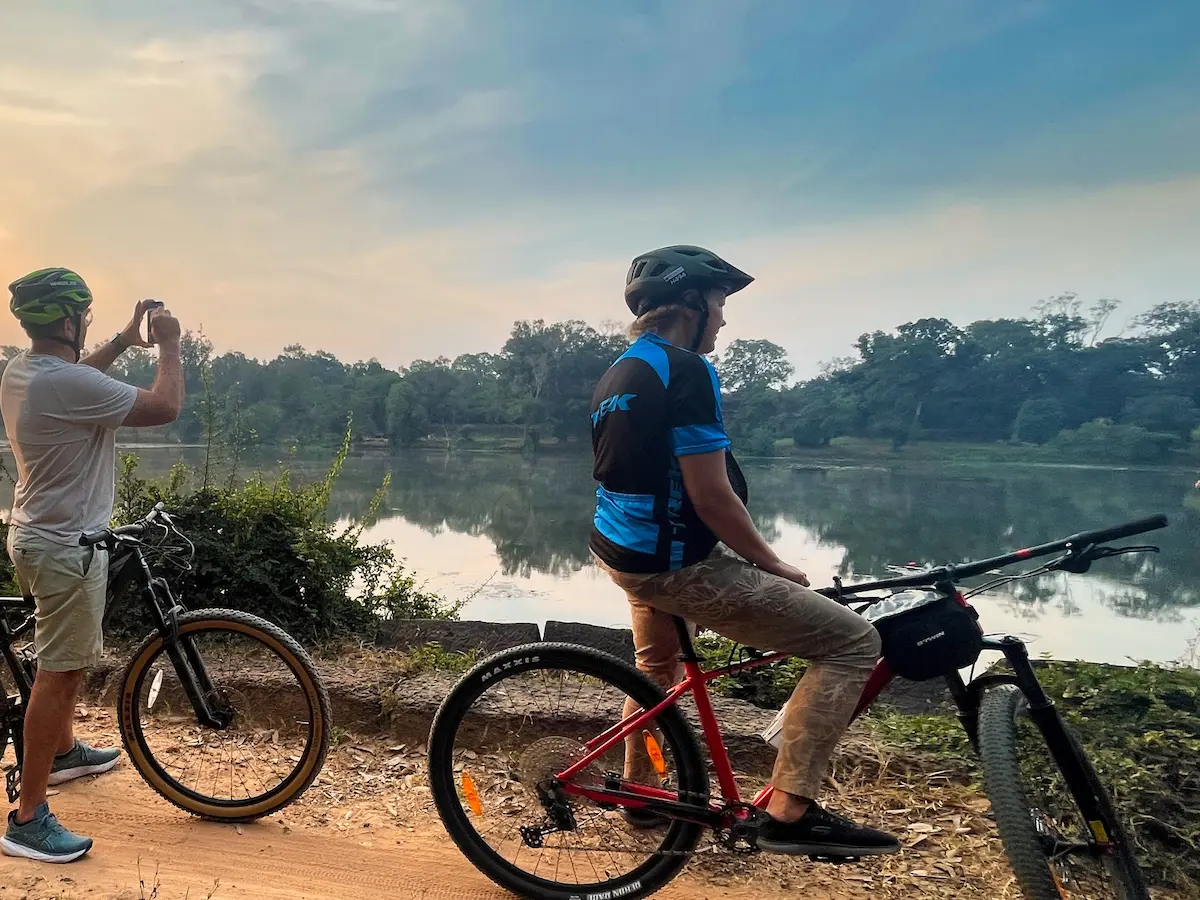
What easy cycling in the heat actually looks like.
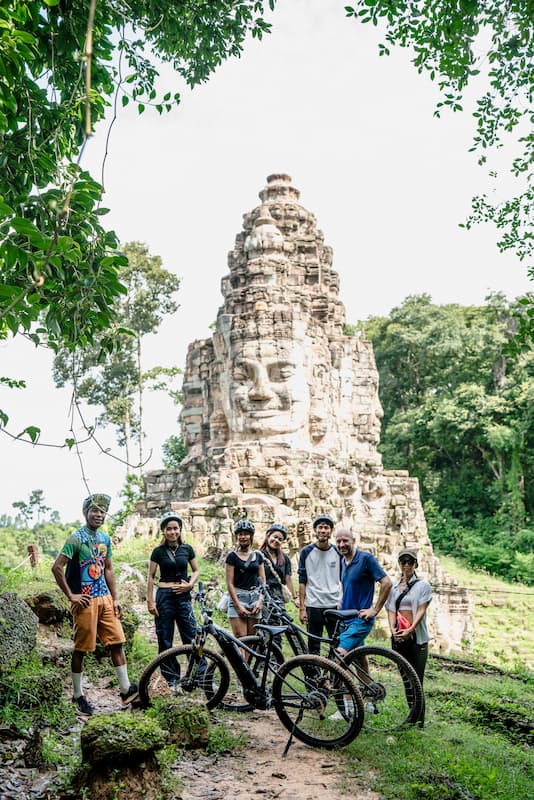
Riding through temple gates tour buses cannot reach.
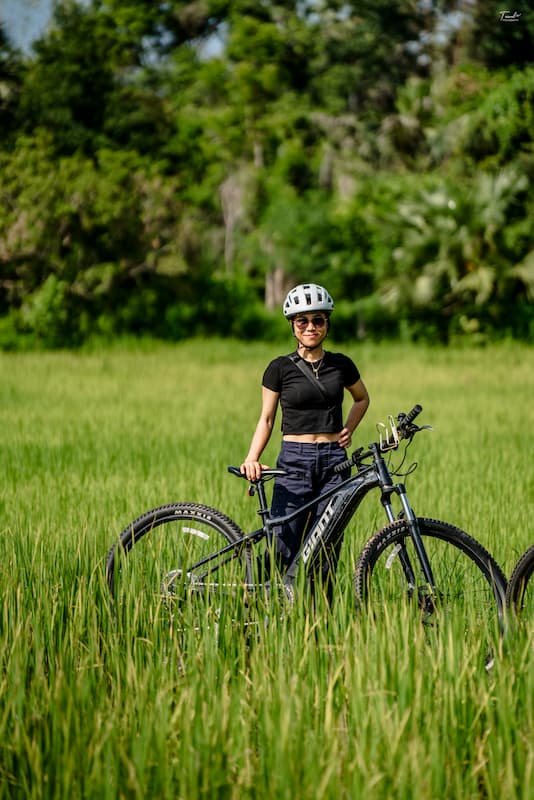
Beyond the temples: rice paddies and village roads.
Our Five E-MTB Tours: Which One Fits You?
We run five e-mountain bike experiences. Each one answers a different kind of visit. All are private (never shared with strangers), all include the Giant Talon E+ e-bike, helmet, water and cold towels, lunch at a local stall we trust, pass assistance, and two Cambodian staff on every ride: your guide riding alongside you and a follower who shadows the group.
SUNRISE
Angkor Sunrise E-MTB
Hotel pickup pre-dawn. Sunrise at Angkor Wat from a quieter angle, then ride Bayon and Ta Prohm before the buses arrive. Finish by 11 AM.
Hotel pickup pre-dawn. Sunrise at Angkor Wat from a quieter angle, then ride Bayon and Ta Prohm before the buses arrive. Finish by 11 AM.
Best for first-time visitors who want the iconic morning without the crowd.
SMALL CIRCUIT
Small Circuit E-MTB
Angkor Wat, Angkor Thom, Bayon, Ta Prohm, Banteay Kdei. Forest trail sections between temples. Counter-clockwise routing.
Angkor Wat, Angkor Thom, Bayon, Ta Prohm, Banteay Kdei. Forest trail sections between temples. Counter-clockwise routing.
The essential one-day Angkor experience by bike.
GRAND CIRCUIT
Grand Circuit E-MTB
Preah Khan, Neak Pean, Ta Som, East Mebon, Pre Rup. Fewer crowds, older forest, the temples most cyclists miss.
Preah Khan, Neak Pean, Ta Som, East Mebon, Pre Rup. Fewer crowds, older forest, the temples most cyclists miss.
Best for repeat visitors or anyone who wants quiet over famous.
SECRET TRAILS
Angkor Secret Trails
Forest trails, hidden gates, a monk blessing ceremony, and temples most visitors will never find. Our most requested tour.
Forest trails, hidden gates, a monk blessing ceremony, and temples most visitors will never find. Our most requested tour.
For travelers who have done the main temples and want the other 90% of the park.
COUNTRYSIDE
Siem Reap Countryside E-MTB
Out of the park, into the rice fields, villages, pagodas, and daily life around Siem Reap. No temples, plenty of Cambodia.
Out of the park, into the rice fields, villages, pagodas, and daily life around Siem Reap. No temples, plenty of Cambodia.
Best paired with a temple day for contrast. The other half of the story.
COMBO
2-Day Small & Grand Circuit
Both circuits back to back. Deepest e-MTB coverage of the park in two days. Included: sunrise morning, monk blessing, picnic breakfast.
Both circuits back to back. Deepest e-MTB coverage of the park in two days. Included: sunrise morning, monk blessing, picnic breakfast.
The one I recommend when guests have the time.
When Is the Best Time to Cycle Angkor?
November through February is peak cycling season. Temperatures sit at 22-32°C, rainfall drops below 25 millimeters per month, and skies stay clear (Climate-Data.org). This is when I would come if I were visiting.
March and April are genuinely hot. Afternoon rides above 38°C are unpleasant on any bike, electric or not. We still run tours but start earlier and cut the midday section. From June to October, afternoon rain becomes the rhythm of the day. Mornings stay clear, the forest turns brilliant green, and the moats fill for the first time since April. Rainy-season cycling is one of the best-kept secrets at Angkor. I genuinely prefer it to January.
Daily Timing
Start early. Leave Siem Reap no later than 7:00 AM for a Small Circuit day, 6:00 AM for Grand Circuit. The ticket office opens at 4:30 AM for sunrise travelers. You want to be at your first temple by 7:30 AM and off the bike by noon to escape the heat. Lunch in town, afternoon at the pool or spa, return for sunset if you still have energy. See our Angkor sunrise guide for the pre-dawn logistics.
What to Bring and What to Wear
Cycling Angkor is both an outdoor sport and a temple visit. You need to dress for both.
- Cover shoulders and knees. The dress code is enforced on the upper level of Angkor Wat. Loose technical trousers work for both riding and temple entry.
- Light, breathable fabric. Merino wool or technical polyester, not cotton.
- Closed-toe shoes. Sneakers or light hiking shoes. Flip-flops are dangerous on the pedals and unsafe on the steep temple stairs.
- Sun hat and sunglasses. Pack a hat for temple visits when the helmet comes off.
- Sunscreen. Reapply every 2 hours.
- Minimum 2 liters of water. On our tours we provide cold water all day.
- Small cash reserve. US dollars in small bills for a coconut, an offering, or a snack.
- Phone and charger. Photos, navigation if self-guided.
IMPORTANT – DRESS CODE ENFORCED
Guards at the upper level of Angkor Wat (the Bakan) check every visitor. Shoulders and knees must be covered. Tight cycling shorts are allowed to ride but will not get you onto the upper level. Pack lightweight trousers in your pannier or day pack.
How to Get From Siem Reap to Angkor
Angkor Wat is 6 kilometers north of central Siem Reap, about 20 minutes by bike on flat road. If you join one of our e-MTB tours, the guide brings the bikes to your hotel and you ride out together. The ride to the park is part of the day, not a commute to skip. Our sunrise tour works differently: tuk-tuk pickup in the dark, sunrise at Angkor Wat, then the bike ride starts after breakfast. Self-guided riders usually bike both ways. For more on arrival logistics and where to stay, see the complete Angkor guide.
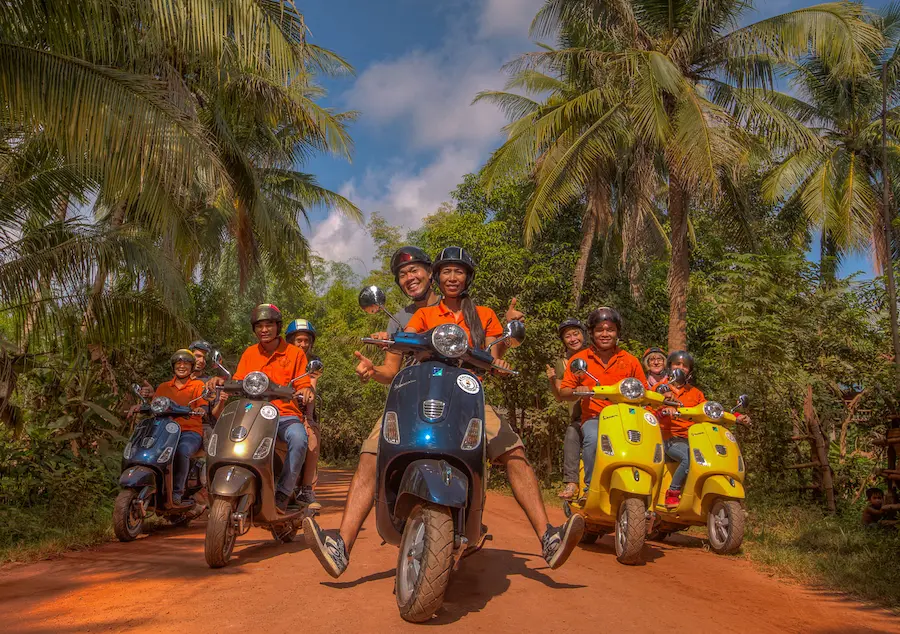
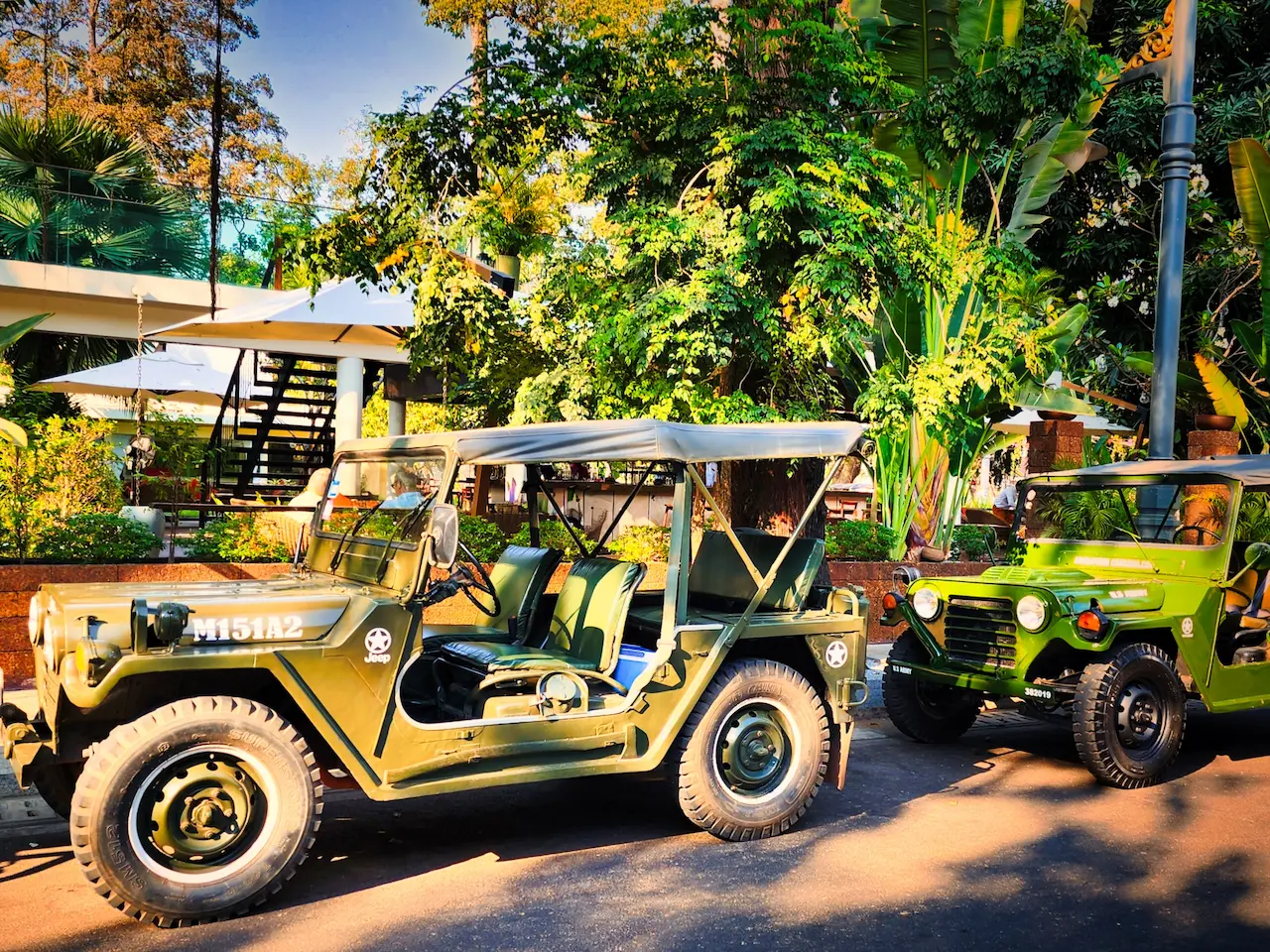
If cycling sounds like more than you want to take on, we also run private Vespa tours and vintage Jeep tours covering the same circuits with zero physical effort. Different vehicle, same insider routing.
Frequently Asked Questions
Is cycling Angkor Wat safe?
Yes. On our guided tours we limit car roads as much as possible and route guests mostly on forest and jungle trails inside the park. When we do use a sealed road, it’s light, slow, and well maintained. The main risks are heat exhaustion, dehydration, and navigation mistakes, not traffic. Every guest wears a helmet, and every tour goes out with two staff: the guide riding alongside you, and a follower who shadows the group and handles anything mechanical on the spot. If something bigger happens, a tuk-tuk back to Siem Reap can be arranged within 15 minutes from almost anywhere in the park.
How long does it take to cycle the Small Circuit?
Plan 6 to 8 hours including temple stops, lunch, and the ride from Siem Reap and back. Pure ride time is 3-4 hours. Most of the day is spent off the bike, inside the temples.
What is the difference between a regular bike and an e-MTB at Angkor?
A regular bike turns Angkor into a physical challenge. An e-MTB turns it into a temple visit that happens to involve cycling. The motor reduces effort by roughly 60-70%. You arrive at each temple ready to explore, not recover. At Cambodia’s temperatures, this matters more than most visitors realize until they try both.
Do I need to be fit to cycle Angkor?
For a self-guided ride on a regular bike, yes. Moderate fitness minimum. For an e-MTB tour with us, no special fitness is needed. We have hosted guests in their seventies, families with young children on trail-a-bikes, and first-time cyclists. The pedal-assist does the work that fitness would otherwise do.
Can children cycle Angkor?
Yes. We offer child seats for toddlers and trail-a-bikes attached to a parent’s e-MTB for kids up to about age 10. Older children ride their own smaller e-MTB. Children under 12 enter the park free with a passport (Angkor Enterprise).
Can I cycle Angkor during the rainy season?
Yes, and it is wonderful. Rain usually falls in the afternoon between 3:00 and 5:00 PM, lasting one to two hours. Mornings stay clear. The forest is greener, the moats are full, the light is dramatic, and the crowds are thinner. We run e-MTB tours year-round.
Do I need to book in advance?
For peak season (November-February) yes, at least two weeks out. Our guides are limited and tours book up. For low season (May-October) a few days’ notice is usually enough. You can book directly on any tour page with live availability updated in real time. For questions before booking, WhatsApp is the fastest channel and you’ll usually hear back the same day.
What happens if it rains during my tour?
We carry light rain ponchos and the guide will read the sky. Most rainy-season storms pass in 45-60 minutes. We find shelter under a temple gallery or at a roadside stall, wait it out, and ride on. If a tour needs to be cut short for weather safety, we offer a partial refund or rebooking.
Can I combine cycling with other tours?
Yes. Many guests do a Small Circuit e-MTB day, then a Vespa food tour in the evening, and a countryside tour the next morning. Multi-tour combos get a discount and are easier to coordinate since we handle all transport.
Where do I buy my Angkor pass?
Online at ticket.angkorenterprise.gov.kh, the official Angkor Enterprise platform. Soft copy on your phone, no queue, no risk of losing a paper pass. If you join our guided tour, we can walk you through it. For details on pricing tiers and what the pass includes, see the complete Angkor guide.