

May 30, 2026
Battambang is the town I send guests to when Siem Reap has worn them out. It sits three hours west on the Sangker River, and it does most of what Siem Reap does at a quarter of the speed: French colonial shopfronts you can photograph without a tour bus in the frame, a circus school that trains children to fly, Angkorian temples with nobody on them, and a food culture good enough that UNESCO took notice. In 2023 Battambang became the first Cambodian city named a UNESCO Creative City of Gastronomy.
Most travelers give Battambang a single day on the way somewhere else. I think that is a mistake. Two days is closer to right. This guide covers how to get here from Siem Reap, what is worth your time once you arrive, the galleries, the food, the tours worth booking, where to sleep, and the slow train south when you leave. I run tours in Siem Reap, not in Battambang, so none of this is a sales pitch. It is what I would tell a friend.
KEY TAKEAWAYS
- Where it is: Three hours west of Siem Reap, on the Sangker River. A slow river town that happens to be Cambodia’s second city by name.
- Getting there: Private car or taxi takes about three hours. Buses take three to four. The boat takes six to nine hours and runs only in the high-water months.
- How long to stay: Two days. One day shows you the headlines and none of the texture.
- What to plan around: The Phare circus, the bamboo train, the bats of Phnom Sampeau at dusk, and the galleries along Street 2.5.
- The food: Battambang is Cambodia’s first UNESCO Creative City of Gastronomy. Eat at Psar Nat market and at Jaan Bai.
- Leaving slowly: A daily Royal Railway train runs south to Phnom Penh in about seven hours, a cheap and scenic highlight in its own right.
Getting to Battambang from Siem Reap
Battambang is an easy half-day from Siem Reap by road. You have three ways in, and they are not equal.
| Option | Time | What to know |
|---|---|---|
| Private car or taxi | About 3 hours | Door to door, and the easiest choice with luggage or children. You can ask the driver to stop along the way. |
| Bus | 3 to 4 hours | The cheapest option. Several companies run the route daily. Pick a seat near the front. |
| Boat | 6 to 9 hours | High-water months only, roughly August to February. Scenic but slow and prone to breakdowns. See the note below. |
Take the road. A private car or a shared taxi gets you there in about three hours, and a bus costs less for an extra hour or so. Both are comfortable enough, and the highway is in good shape the whole way.
The boat is the one I talk guests out of, and I will say it plainly: this is not an easy way to travel. It runs only when the water is high, roughly August to February. When it runs at all, it is six to nine hours on a hard bench with the engine in your ears, and longer when the boat breaks down, which it often does. There is no comfortable version of this boat, and no timetable you can count on. The countryside genuinely is beautiful from the water. It is not nine hours of beautiful. If you want the river, take a one-hour sunset cruise once you are in Battambang instead, and keep your travel day for the road.
MY PICK
Treat Battambang as a two-day side trip from a Siem Reap base. Drive over in the morning, stay two nights, and leave south by train. If you are still planning the Siem Reap half of your trip, our Angkor tours pair naturally with a Battambang add-on. Battambang itself you can do independently. It is that kind of town.
Phare Ponleu Selpak: The Circus and the Art School
If you do one thing in Battambang, make it a circus night at Phare Ponleu Selpak. The name means “the brightness of the arts.” It began in 1994 as a drawing project for children coming out of the border refugee camps, and it grew into a school that now teaches music, theatre, animation, and circus to hundreds of young Cambodians.
The circus is the part visitors see. Students perform a few evenings each week under a big top on the campus, and the show is acrobatics and aerial theatre built around a story, usually a Cambodian one. The performers are teenagers and young adults who train here full-time, and ticket money funds the school. I always tell guests this is the reason to come to Battambang. Most of them agree with me by the interval. Show nights change, so check the current schedule before you plan your evening.
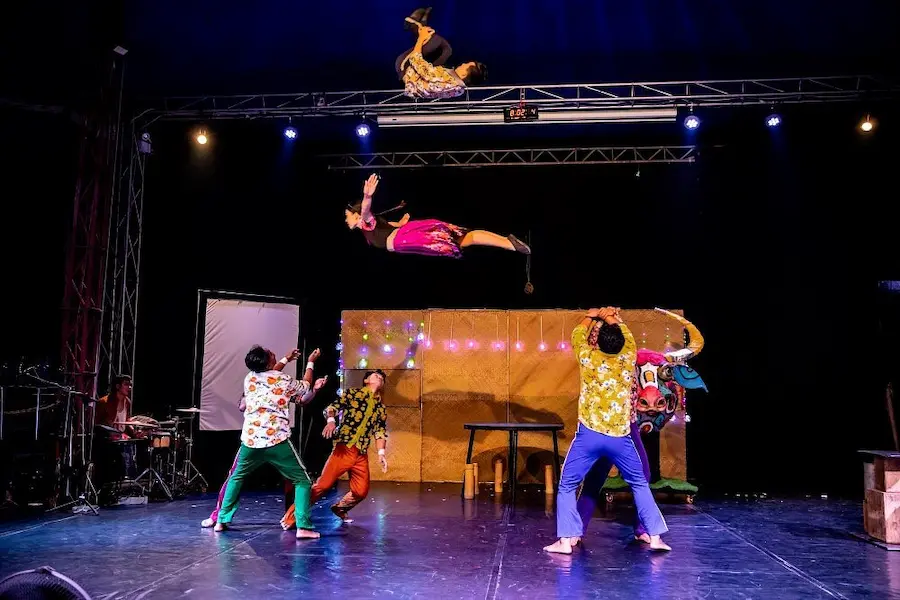
Every few years Phare also hosts the Tini Tinou International Circus Festival, which it founded in 2003. The 2024 edition brought fourteen circus troupes from twelve countries for a week of shows across the town. There is no fixed annual date, so check the Phare Ponleu Selpak schedule when you plan your trip. The everyday student shows run year-round regardless.
If you have already seen Phare, The Cambodian Circus in Siem Reap, this is where it comes from. The Siem Reap show is the polished touring arm. Battambang is the school behind it, and watching the students on their home campus feels closer to the bone.
The Bamboo Train and the Bats of Phnom Sampeau
Battambang actually has two bamboo trains. The norry is a flat bamboo platform on two axles, fitted with a small engine, that runs along an old rail line. The original is at O Dambong, a few kilometres east of town, and it is the one with the history: an improvised local railway that became a tourist ride. For years people have said it is about to close, because the government keeps planning to put scheduled trains back on that stretch of track. It keeps not happening. As of 2026 the O Dambong train still runs, a few dollars for the trip, and there is a newer purpose-built bamboo train out near Wat Banan if you want a backup.
Here is what I would do: ride the O Dambong one while it is still there. The platform reaches a real speed, the rice fields blur past, and when a norry comes the other way, one of the two is lifted clear of the rails by hand to let the other through. That part has not changed in decades, and it is the best bit.
Late in the afternoon, drive out to Phnom Sampeau, a hill about fifteen minutes from town. Around dusk, bats start to pour out of a cave high in the cliff face, and they do not stop. The column twists out in a continuous ribbon for a good half hour as they head off to feed. Get there before the light goes, buy a cold drink from a stall at the base, and watch. It is free, and it is one of the strangest and best things you will see in Cambodia.
The same hill holds the Killing Caves, a memorial to people executed here under the Khmer Rouge. It is a heavy, quiet place. Worth the short climb if you want to understand the province, but go in knowing what it is.
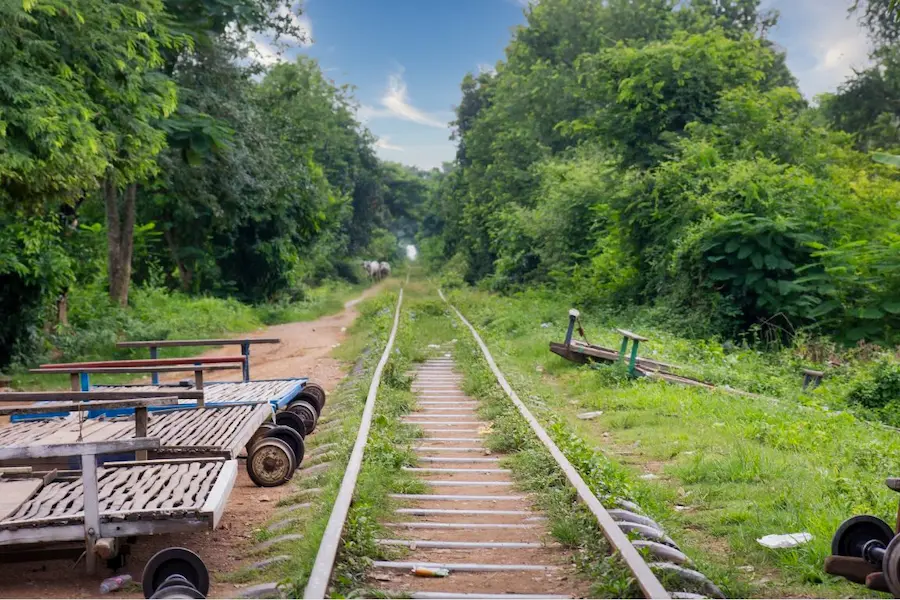
The O Dambong bamboo train, still running in 2026.

Dusk at Phnom Sampeau, as the bats come out.
Temples and Countryside Around Battambang
Battambang province has its own Angkorian temples. They are older in feel than most of what you see at Angkor, and almost empty. If you have already spent days among the Siem Reap temples, these will feel familiar and very quiet.
Wat Banan sits on a hilltop south of town, five towers in a row, and it is often called a smaller Angkor Wat. The comparison is generous. But the steep stone stairway up earns you a real view over the rice fields, the ticket is a couple of dollars, and you will likely have it to yourself. Wat Ek Phnom, north of the centre, is an eleventh-century ruin beside a moat, partly collapsed, with a large modern Buddha built next to it. The old stone and the new statue side by side is the interesting part.
Kampong Pil Pagoda, on the edge of town, rewards a slow look for its carved detail and the suspension footbridge over the Sangker beside it. And if you have a half-day and some energy, the ride out toward Pheas Reservoir runs through flat green rice country. That ordinary Cambodian landscape is the thing I think people remember longer than the temples.
Battambang’s Food and Its UNESCO Gastronomy Title
In October 2023, Battambang became the first city in Cambodia to join the UNESCO Creative Cities Network, in the gastronomy category. That sounds grander than it looks on the ground, and the gap is the charm of it. There are no white-tablecloth restaurants here. The recognition is for the everyday food: the rice, the freshwater fish, the fruit, and a handful of dishes the province does better than anywhere else.
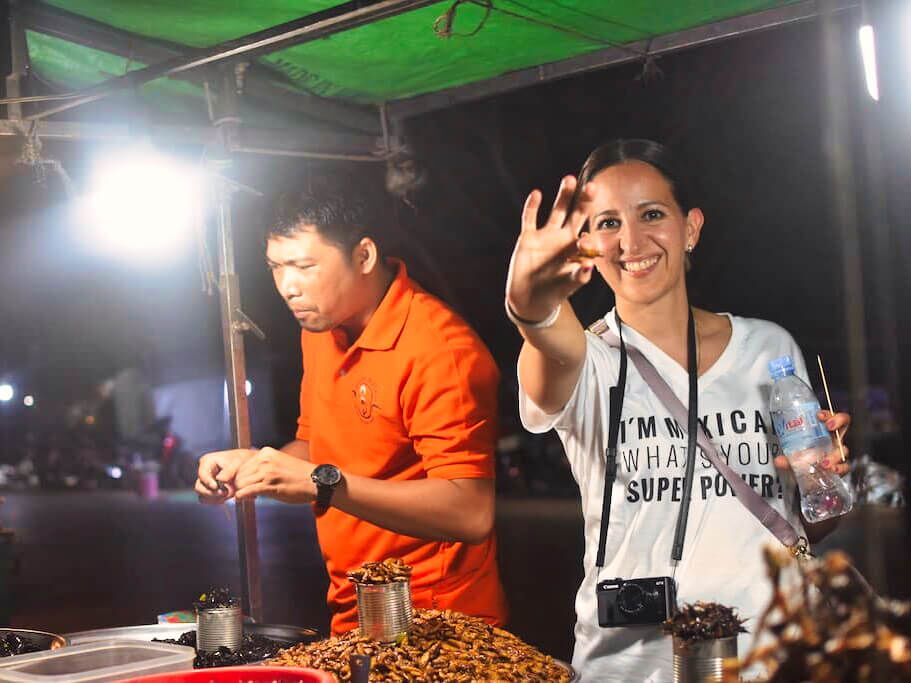
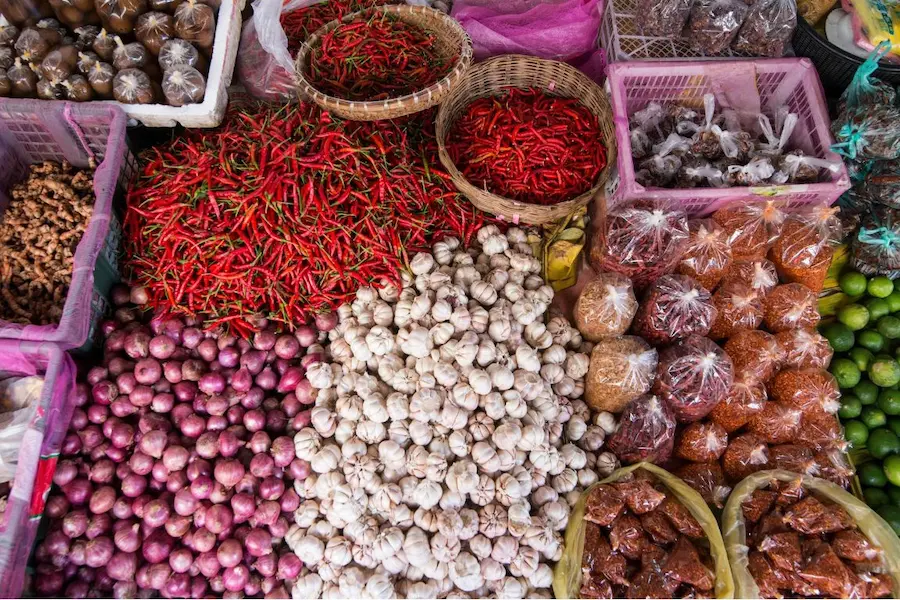
Start at Psar Nat, the central market. It is where I would send you for breakfast: nom banh chok, the rice-noodle bowl with fish gravy and a pile of raw herbs, eaten on a low stool before the heat builds. Look for the deep-fried bananas and the turmeric-yellow pork pancakes too. Markets here run on small riel notes and dollars, and our Cambodia currency guide covers how that works if you are new to it.
For dinner, Jaan Bai is the address most people agree on. It is a social enterprise restaurant that trains young Cambodians in hospitality, the cooking is genuinely good, and the grilled river fish is the dish I would order. Battambang will not overwhelm you with restaurant choice. What it has, it does well.
The Art Galleries, the Museums and the Colonial Town
Battambang has been Cambodia’s art town for two decades, and a slow afternoon among its galleries is the part of a visit I would protect time for. They are small, often free, and usually run by the artists themselves.
Romcheik 5 Art Space is the one to start with: a contemporary gallery of Cambodian painting and sculpture, with a rooftop cafe added in recent years for sitting with what you have just seen. Human Gallery is the photographer Joseba Etxebarria’s space. He spent over a decade travelling the world for a human-rights project, the gallery shows the photographs from it, and a share of every sale funds children’s education through his Wings for the Future work. Tep Kao Sol shows watercolours and the mixed-media work of the artist Loeum Lorn. And Lotus Bar and Gallery, set in a colonial building in the heritage district, hangs rotating contemporary shows above a bar, which is a very Battambang combination.
Here is the catch. The scene is smaller than it was. Street 2.5, the lane locals still call the gallery street, has lost a couple of its spaces in recent years. It is still worth walking, but go expecting a quiet handful of good rooms rather than a busy art district. That is the truthful version, and it is still a good afternoon.
For older work, the small Battambang Provincial Museum holds Angkorian-era pieces gathered from the province’s temples. And there is more on the way. SOSORO Battambang, a branch of Phnom Penh’s museum of money and economic history, is expected to open in late 2026, though opening dates here have a way of slipping.
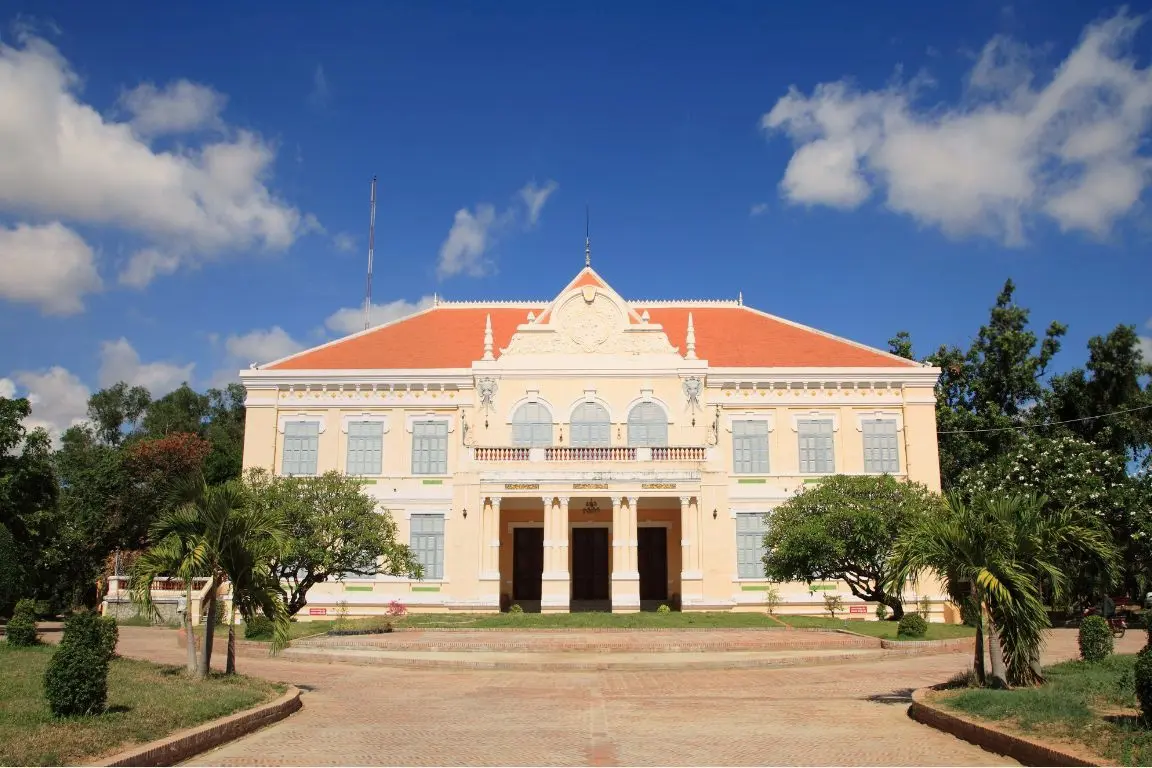
The town itself is the other gallery. Battambang has the best-preserved French colonial streetscape in Cambodia: rows of shophouses with their original shutters, and the old Governor’s Residence by the river with its mix of French and Khmer detailing. Walk it in the early morning or the late afternoon, when the light is on the buildings and the heat has eased. A row of cafes has grown up along the riverfront if you need an hour out of the sun.
Tours, Cooking Classes and the River
Battambang rewards anyone who books a thing or two rather than only walking the streets. A few are worth your time.
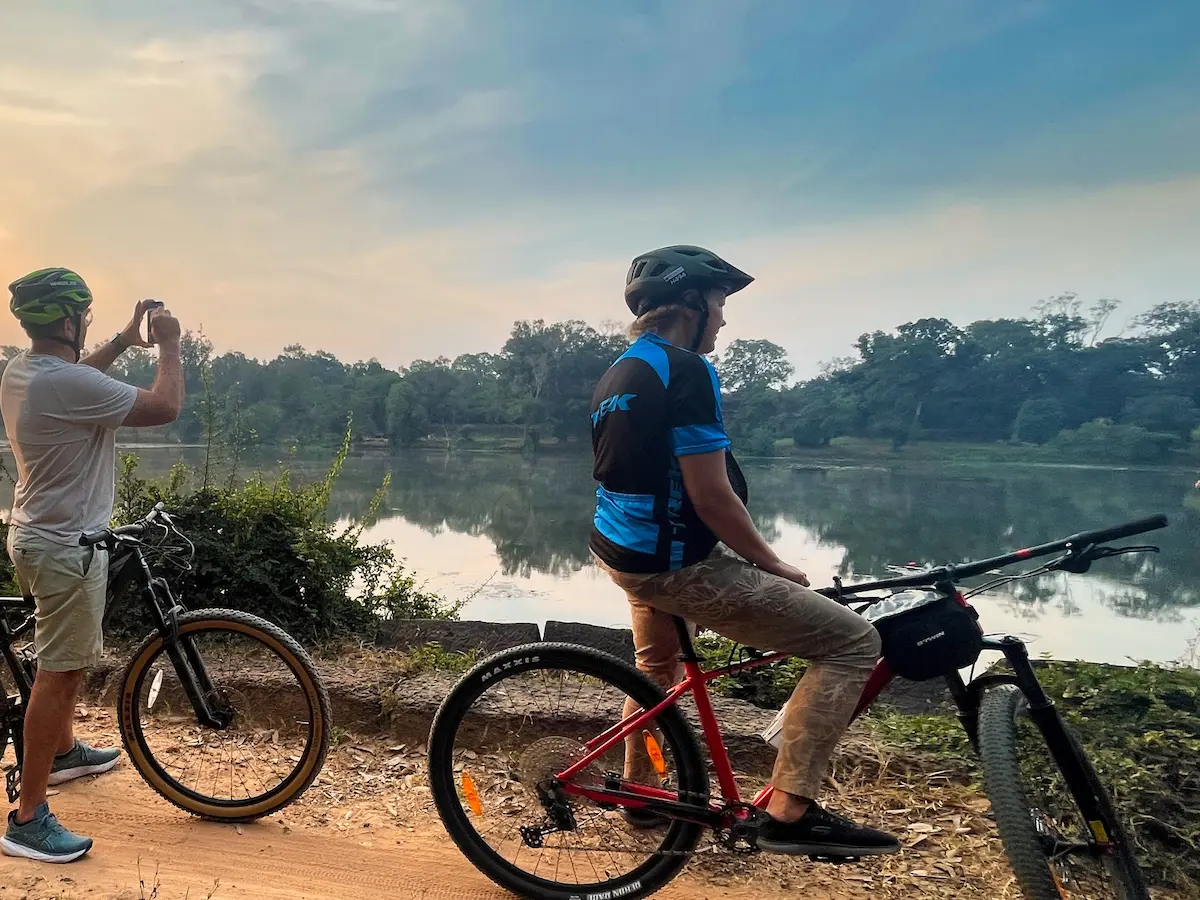
The countryside is the headline. Soksabike, a long-running social enterprise, runs half-day and full-day cycling tours out into the villages, stopping at the workshops where families make rice paper and distil rice wine, with a rural lunch along the way. It is gentle riding on flat ground, and it is the clearest window into working Cambodian life you will get here. If you would rather not cycle, the same kind of route works by tuk-tuk with a local guide.
On the water, a slow boat up the Sangker River in the late afternoon takes you past stilt villages and a fruit farm and gets you back for sunset. Kayaks run on the river too. And if you want to take something home, Battambang has good Khmer cooking classes that begin with a market walk and end with you eating what you cooked.
On a tight schedule, you can string the main sights into one tuk-tuk loop: a hilltop temple, a workshop or two, the bamboo train, and the bats at dusk to finish, in an order that makes the timing work. Most guesthouse owners can put you with a driver they trust. That is how I would do it with only one full day.
Where to Stay in Battambang
Battambang is short on high-end hotels. If you want a full resort, this is not the town for it, and I would plan accordingly. For everyone else there is plenty of choice, most of it good value. I have stayed in two places I would recommend without hesitation.
Maisons Wat Kor sits in Wat Kor village just outside the centre. It is a small boutique hotel built in traditional Khmer style, with large rooms, quiet grounds, and the personal service that comes from a family-run place. Choose this one if you want calm. La Villa is the opposite mood: a restored 1930s French colonial house right in town, seven rooms, with a pool, a garden, and the colonial landmarks on its doorstep. Choose this one if you want to walk everywhere.
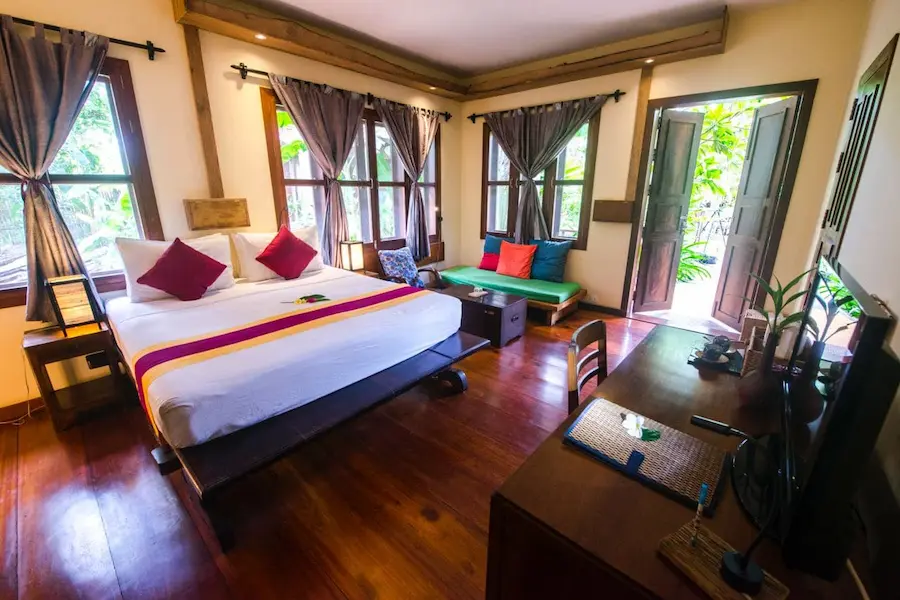
Maisons Wat Kor, in Wat Kor village.
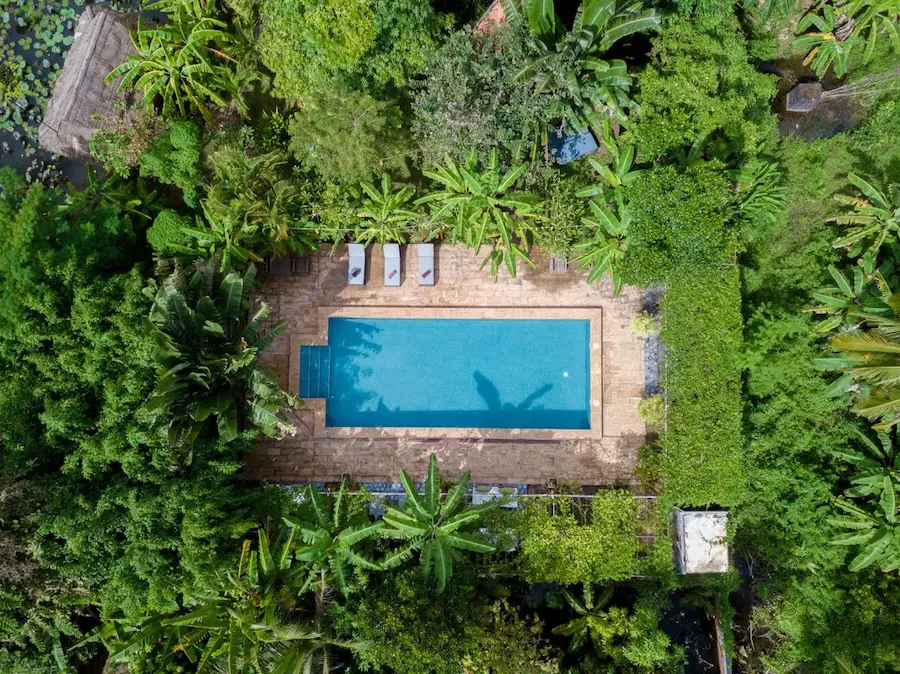
Quiet grounds at Maisons Wat Kor.
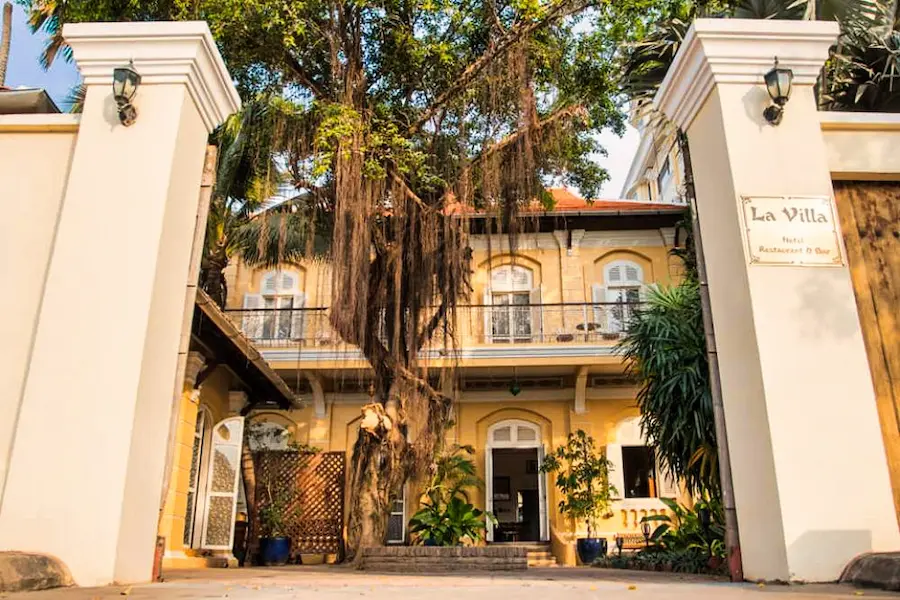
La Villa, a restored 1930s colonial house.
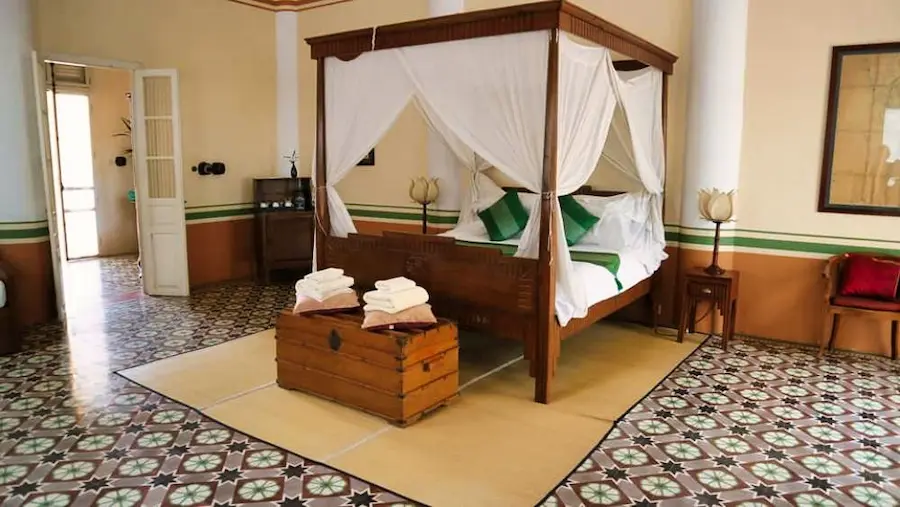
A colonial-style room at La Villa.
The Train to Phnom Penh: A Slow Way Out
When it is time to leave Battambang, think about the train. Cambodia’s Royal Railway runs one passenger train south to Phnom Penh every day. It leaves Battambang at three in the afternoon and reaches Phnom Penh around ten at night. Seven hours. That sounds long until you do it. Then it becomes the calmest stretch of the trip: rice country and small provincial stations sliding past the window at a pace that makes a bus feel frantic. Tickets cost only a few dollars.
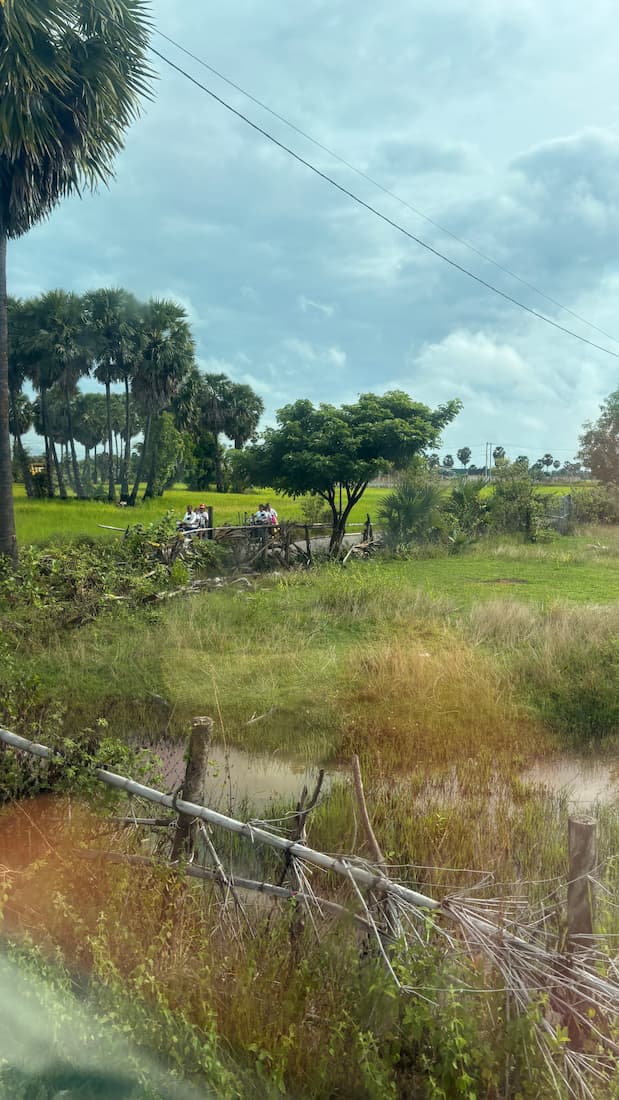
Rice country from the train window.
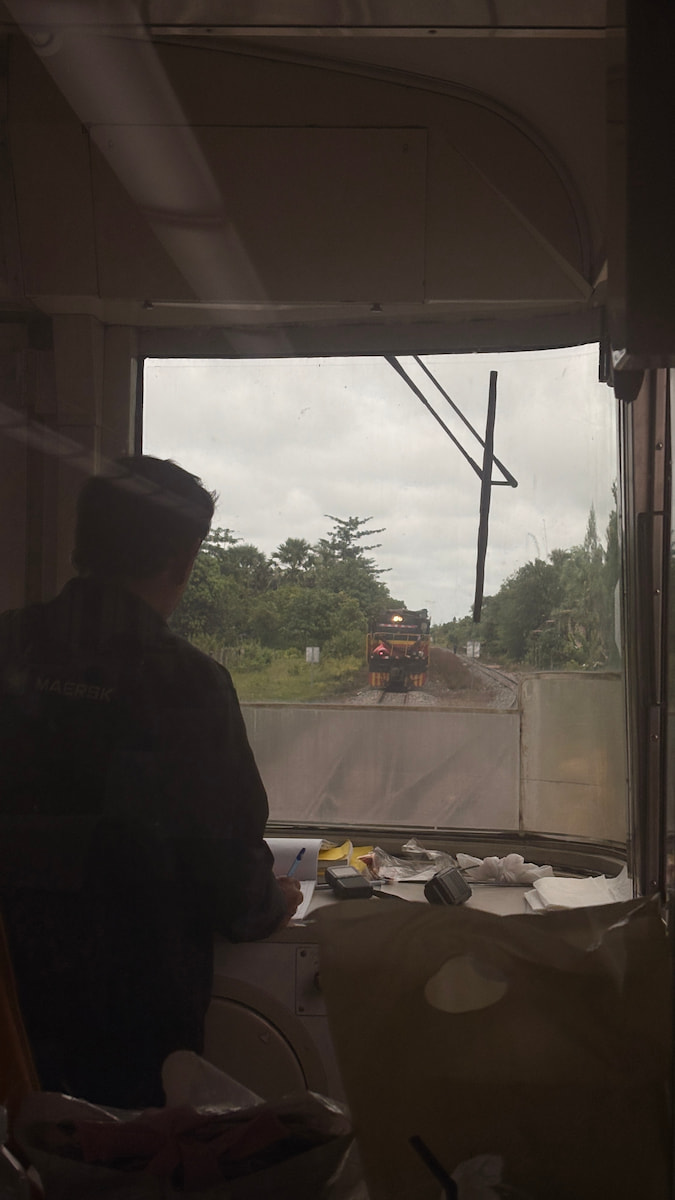
Onboard the slow train south.
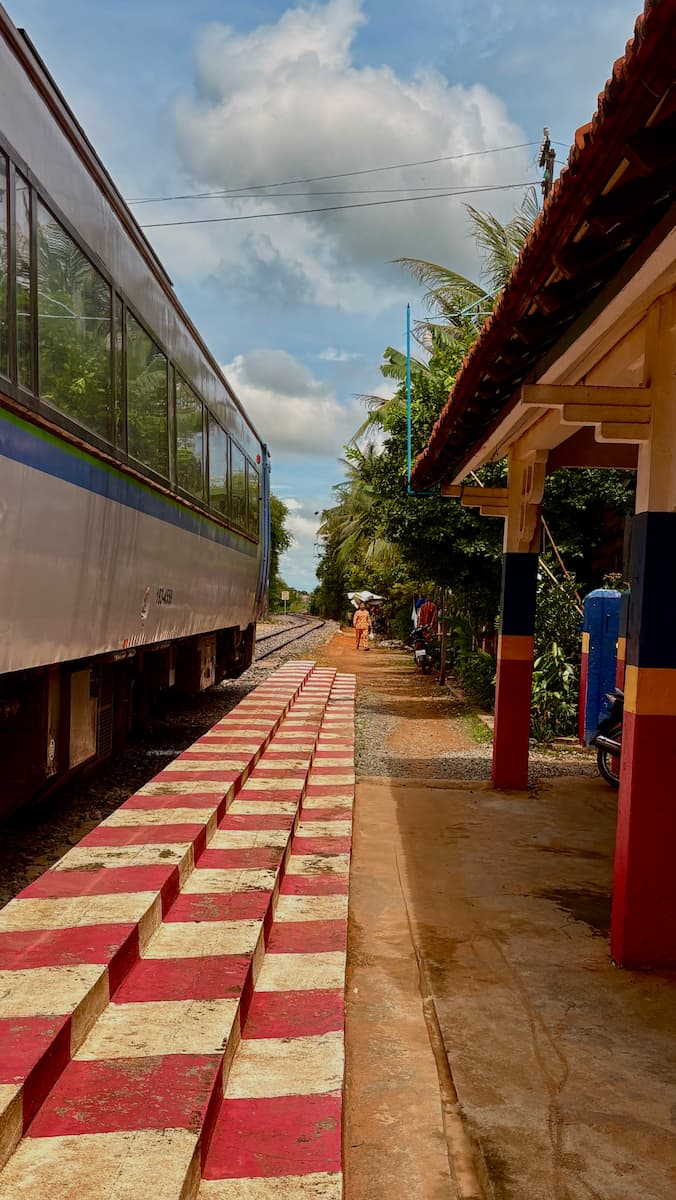
A stop at a small country station.
Two practical notes. It is a single daily departure, so the train sets the shape of your day. And you reach Phnom Penh late, so have a bed booked there before you board. Timetables in Cambodia still shift, so confirm the current times with Royal Railway when you plan. If the timing works, take the train. I would choose it over the bus every time.
Battambang FAQ
Is Battambang worth visiting?
Yes, if you have the time. Battambang gives you Cambodian art, good food, French colonial streets, and quiet Angkorian temples without the crowds of Siem Reap. Skip it only if your trip is very short. Two days here is well spent.
How many days do you need in Battambang?
Two days is the sweet spot. One day lets you see the bamboo train, a temple, and a circus show, but nothing slowly. A third day suits anyone who wants to linger in the galleries and the river cafes.
How do you get from Siem Reap to Battambang?
By road in about three hours, by private car, shared taxi, or bus. A boat also runs in the wet season but takes eight hours or more. The road is the sensible choice for almost everyone.
Is the boat from Siem Reap to Battambang worth it?
Only if the slow river trip is the point of your day. It runs in the high-water months, takes six to nine hours when all goes well, and the seating is basic. The scenery is real, but the boat is prone to breakdowns, and most travelers are happier taking the three-hour road and a short river cruise once they reach Battambang.
Is the Battambang bamboo train still running?
Yes. As of 2026 the bamboo train at O Dambong still runs, despite years of talk that the government will replace it with a scheduled rail line. That closure has been predicted for a long time and keeps not happening, but it could, so ride it while you can. A second, purpose-built bamboo train also operates near Wat Banan.
Can you take a train from Battambang to Phnom Penh?
Yes. Cambodia’s Royal Railway runs one train a day south to Phnom Penh. It leaves Battambang at 3 PM and reaches Phnom Penh around 10 PM, about seven hours, for a few dollars. It is a slow, scenic ride and a favourite of unhurried travelers. Confirm the current times with Royal Railway when you book.
What is Battambang known for?
Phare Ponleu Selpak, its circus and art school. The bamboo train and the bat caves at Phnom Sampeau. French colonial streets and a real gallery scene. And the food: in 2023 Battambang became Cambodia’s first UNESCO Creative City of Gastronomy.
Is Battambang safe for tourists?
Yes. Battambang is calm and used to visitors, and the same common-sense precautions you would take anywhere apply here. For health, transport, and current travel notes, see our guide to safety in Cambodia.