

May 30, 2026
The bas-reliefs of Angkor Wat are the carved panels that wrap the temple’s outer gallery: more than 1,000 square metres of sandstone, cut in shallow relief, telling the great Hindu epics and one long panel of real 12th-century Khmer history. Eight panels in all. Most people walk the gallery in fifteen minutes and remember none of it.
I grew up in the pagoda inside the walls of Angkor Wat. Southern Angkor Pagoda, still standing, on your left as you face the temple, behind the food vendors. My grandfather was its Grand Abbot, and he had me learning Sanskrit from palm leaves as a girl. So I will tell you something a guidebook will not. As a child, I found this gallery boring. A long grey wall in the heat. It took someone stopping me in front of one panel, telling me the story carved into it, before the wall began to talk.
That is the job of this guide. Not to list eight panels. To slow you down in front of the few that will stay with you for years.
Key Takeaways
- The bas-reliefs run around the outer gallery on the first level of Angkor Wat: eight large panels, more than 1,000 square metres of carving.
- Seven panels tell Hindu epics. One, the Army of Suryavarman II, is a portrait of the actual 12th-century king and court who built the temple.
- The gallery reads counterclockwise, which the conservator Maurice Glaize linked to Khmer funerary ritual.
- If you see only one, make it the Churning of the Sea of Milk: nearly 50 metres of gods and demons in a tug of war.
- Give the gallery an hour, and bring someone who knows the stories. Unread, the panels are just a wall.
What Are the Bas-Reliefs of Angkor Wat?
A bas-relief is a carving cut into a flat surface, with the background chiselled away so the figures stand a little proud of the wall. At Angkor Wat the reliefs cover the inner face of the gallery that runs around the temple’s first level, roughly two metres tall and unbroken for hundreds of metres. Glaize, who rebuilt much of Angkor as its conservator between 1937 and 1945, called the carving more graphic than sculptural. He meant it is shallow, closer to drawing in stone than to deep sculpture. Stand close and you see it: the lines are fine, the relief is barely a finger deep.
The temple was built in the 12th century by King Suryavarman II, who reigned from 1113 to about 1150, and the work took roughly three decades (Encyclopaedia Britannica). It was dedicated to the Hindu god Vishnu and built as the king’s funerary temple. The reliefs are central to the temple, not a finishing flourish on top of the architecture. The stories they carry were the ones my grandfather’s generation still knew by heart.
Seven of the eight panels come from Hindu scripture, mostly the two great epics, the Mahabharata and the Ramayana. The eighth is different. It shows Suryavarman II himself, his ministers, and his army on the march. That panel is the closest thing we have to a photograph of the court that ordered all of this carved.
How Is the Gallery Arranged?
The gallery is a square corridor. Each of its four sides is split into two halves by the corner pavilions, which gives eight long sections, one major panel each. You read them counterclockwise, keeping the wall on your left. That detail matters more than it sounds. Counterclockwise is the reverse of the direction a Hindu pilgrim walks around a living shrine. Glaize, and others after him, read that reversal as funerary: the temple was built for a dead king, and you move through his gallery the way mourners move, against the usual current.
Most visitors enter from the west, the main causeway side. Turn left into the gallery and the first panel is the Battle of Kurukshetra. Here is the honest problem with the gallery, and I have watched it for years: walk it once, fast, with no guide and no stories in your head, and you will remember a blur of arms and elephants. The table below is the map I would hand a friend before they went in.
| Panel | Where in the gallery | The story |
|---|---|---|
| Battle of Kurukshetra | West gallery, south half | The final battle of the Mahabharata |
| Army of Suryavarman II | South gallery, west half | The real king and his marching army |
| Heaven and Hell | South gallery, east half | Yama judges the dead |
| Churning of the Sea of Milk | East gallery, south half | Gods and demons churn for immortality |
| Vishnu and the Asuras | East gallery, north half | Vishnu defeats a demon army |
| Krishna and Bana | North gallery, east half | Krishna defeats the demon Bana |
| Gods and Asuras | North gallery, west half | The gods fight the demons, each on its mount |
| Battle of Lanka | West gallery, north half | The Ramayana’s final battle |
Panels and locations after Maurice Glaize, The Monuments of the Angkor Group.
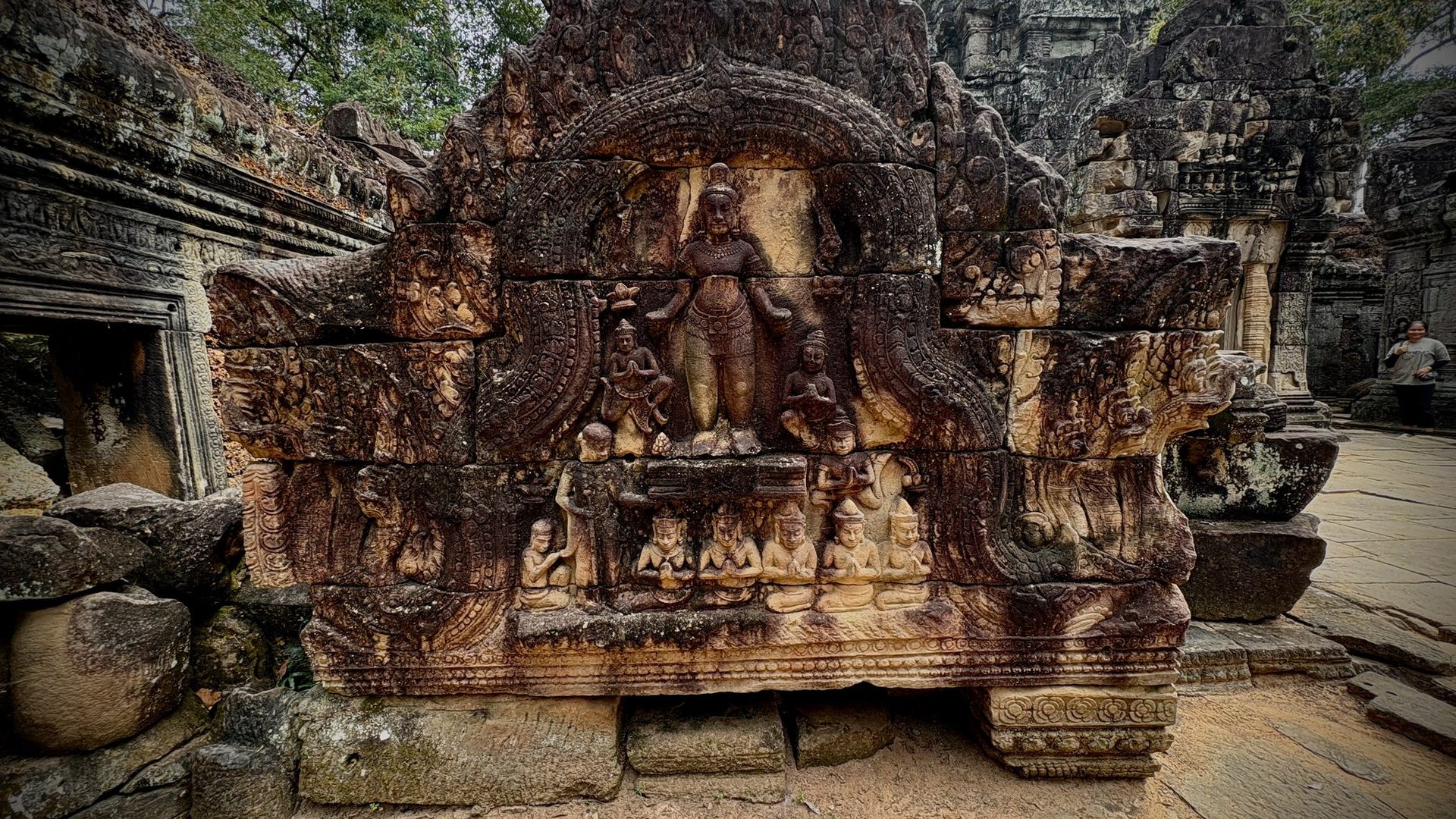
Low relief, cut barely a finger deep into the sandstone.
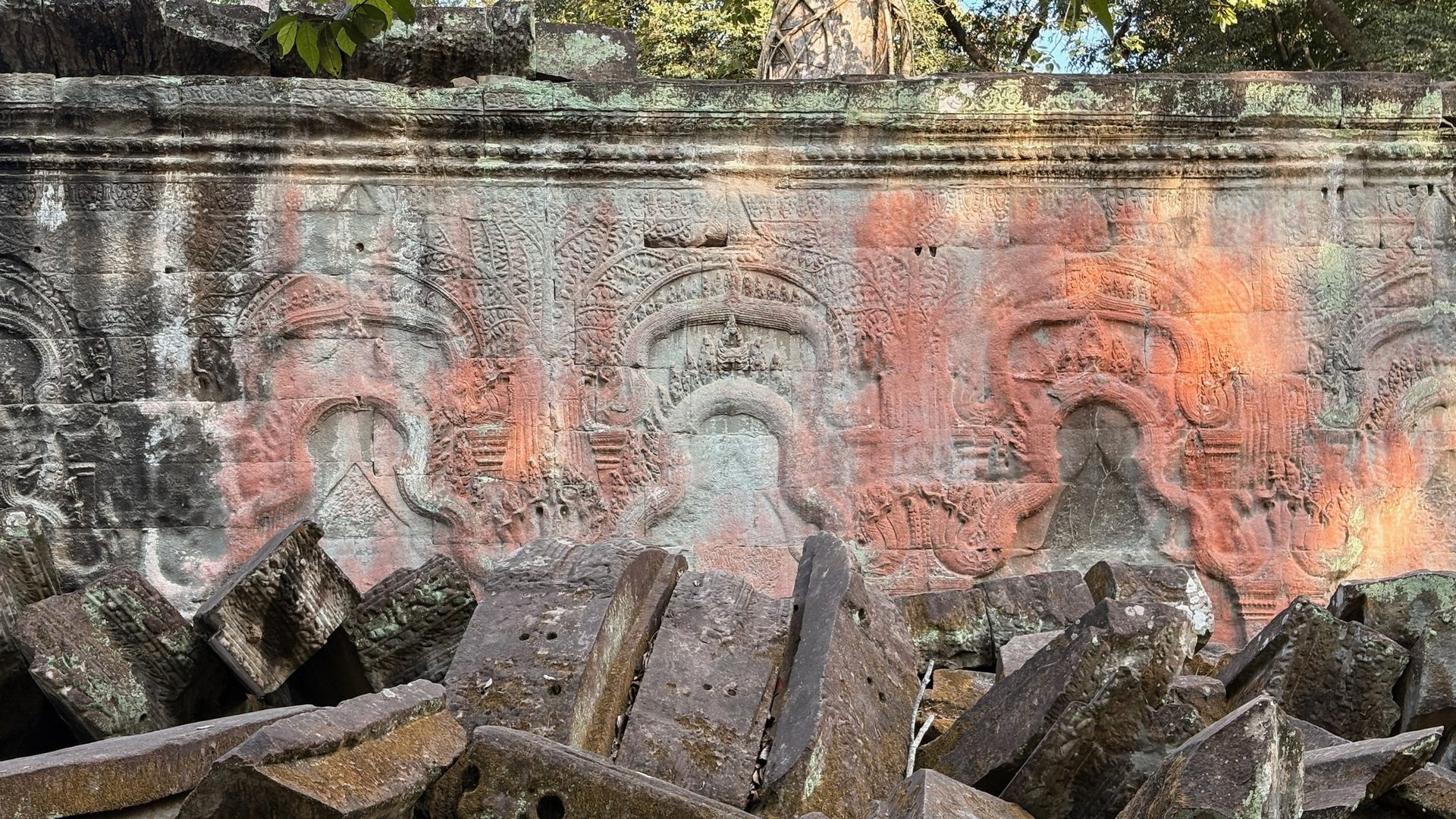
Figure after figure, the kind of carving that runs the length of the gallery.
The Eight Great Panels of Angkor Wat
Here they are in the order you meet them walking counterclockwise. Read this before you go in, not in front of the wall. You want your eyes on the stone, not on a screen.
1. The Battle of Kurukshetra
The west gallery, south half. This is the climax of the Mahabharata, the war between two branches of one family, the Kauravas and the Pandavas. The two armies enter from opposite ends of the panel and collide in the centre, and the carving gets denser and more violent as you walk toward that meeting point. Rank on rank of foot soldiers, with officers riding above the crush in chariots. By the middle, the dead are layered on the ground. It is a family destroying itself, and the carvers built that feeling into the spacing of the figures.
2. The Army of Suryavarman II
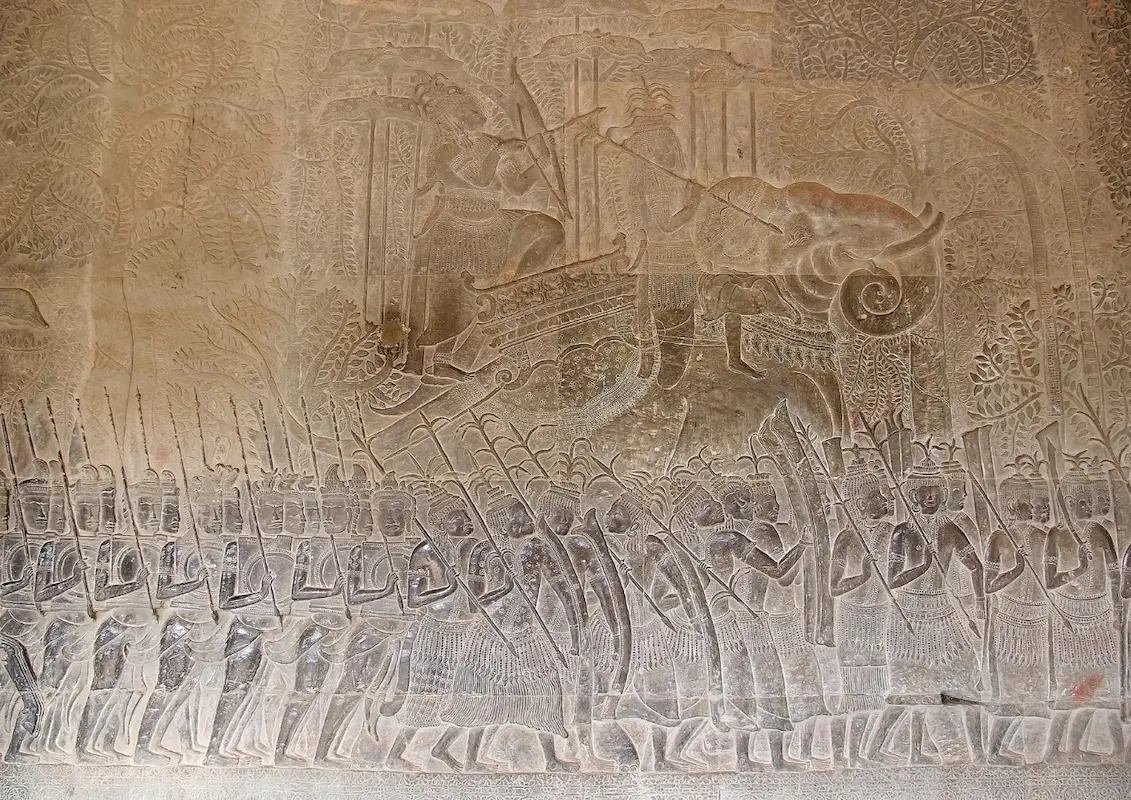
The south gallery, west half. If you skip everything else, do not skip this one. Every other panel is myth. This one is history. It shows Suryavarman II, the king who built Angkor Wat, reviewing his army. The panel runs ninety metres, the longest in the gallery. He is carved larger than the men around him, seated, with a tier of parasols above him to mark his rank. Old Khmer inscriptions are cut beside the figures. Twenty-eight of them name his commanders, and one names the king himself by the title he was given after death: Paramavishnuloka, he who has gone to the world of Vishnu. When I stand here I am looking at the people who gave the order to carve the wall I am standing in. That is a strange and close feeling. Nine hundred years thin out to nothing.
3. Heaven and Hell
The south gallery, east half. Yama, the god of the dead, judges souls and sends them up or down. The panel is carved in three registers, stacked one above another. Along the top, the blessed are carried toward the heavens. The bottom register is the hells, and the punishments there are specific and grim. Between them runs the passage of the dead on their way to judgement. This panel has suffered. Parts of it are cracked and worn, and some sections were repaired long ago. Read it slowly anyway. It is the Khmer picture of what waits after death, carved on the wall of a tomb.
4. The Churning of the Sea of Milk
The east gallery, south half. This is the one. Nearly 50 metres long, and the finest carving in the temple. The story: the gods had lost their strength, and the elixir of immortality, amrita, lay at the bottom of the ocean. To raise it, gods and demons had to do something they hated. They had to cooperate.
They used a mountain, Mount Mandara, as a churning pole, and the serpent Vasuki as the rope wrapped around it. Demons pull the serpent’s head, gods pull its tail, and the mountain spins and churns the ocean. Vishnu stands at the centre, holding everything in balance, and below him his tortoise self braces the foot of the mountain so it cannot sink. Glaize counted the figures: 92 demons hauling on one side, 88 gods on the other. From the churned ocean rise the goddess Lakshmi and the white elephant of the gods. For the full myth, the Encyclopaedia Britannica and the Smithsonian’s National Museum of Asian Art both lay it out well.
There is a famous reading of this panel by the scholar Eleanor Mannikka, in her book Angkor Wat: Time, Space, and Kingship. She argues the figures are a calendar. In her count there are 91 demons, marking the 91 days from the winter solstice to the spring equinox, and 88 gods, marking the 88 days from that equinox to the summer solstice. It is worth knowing that the count itself is debated: Glaize on the wall counted 92 demons, Mannikka counts 91. Honestly, I find the disagreement the most human thing about the panel. Even now, nobody can quite agree on what is carved there.
5. Vishnu and the Asuras
The east gallery, north half. Vishnu, mounted on the bird Garuda, cuts through an army of asuras. Stand here and look at the carving, then think back to the Churning panel you just left. The quality drops. The figures are stiffer, the work quicker. You have walked into the part of the gallery the original builders never finished.
6. Krishna and Bana
The north gallery, east half. Krishna, also on Garuda, rides against the thousand-armed demon Bana, and the god Shiva steps in to settle the fight. This is one of three northeast panels left unfinished when work on the temple stopped, probably soon after Suryavarman II died. Later hands completed them, and the carving shows it. I tell guests this on purpose. A temple is not a perfect object handed down whole. It is a worksite that ran out of time.
7. The Gods and the Asuras
The north gallery, west half. Twenty-one gods, each in single combat with a demon, and the pleasure of this panel is the mounts. Every god rides his own animal, so you can name them as you walk: Yama on his buffalo, Shiva on the bull, Skanda on the peacock, Indra on the elephant. Slower than the Churning, but a good game for tired eyes near the end of the loop.
8. The Battle of Lanka
The west gallery, north half, and the carving is fine again here, back in the hands of the first builders. This is the end of the Ramayana: Prince Rama, with the monkey army of Hanuman, storms the island fortress of the demon king Ravana to win back his wife Sita. It is the most chaotic panel in the temple, a knot of monkeys and demons, and it leaves you back near the western entrance where you began.
One more thing, if you have time for it. The two pavilions at the western corners of the gallery carry their own carving, smaller and denser than the eight great panels: about a dozen scenes in each, mostly the Ramayana and the legends of Vishnu. Glaize numbered every one. Most visitors never put their head through the pavilion door. You should.
Who Are the Apsaras and Devatas?
The eight epic panels are not the only carving at Angkor Wat. Look up from the gallery wall, onto the pillars and the inner courtyards, and the temple is covered in carved women. There are two kinds, and guides mix them up constantly.
A devata is a standing female figure, carved alone or in small groups, facing forward, feet on the ground, calm. She is a guardian, a presence. An apsara is a dancer, smaller, shown mid-movement or in flight, often in a group. Devatas hold still. Apsaras move. Once you have the difference, you cannot stop seeing it.
How many are there? It depends who counted. In 1927 the scholar Sappho Marchal catalogued 1,737 devatas, studying their hair, their jewellery, the flowers in their hands. Decades later the German Apsara Conservation Project, with the researcher Kent Davis, inventoried 1,796. Either way, the temple carries close to two thousand individual carved women, and the detail people repeat, correctly, is that no two faces are the same. As a child I had a favourite. She is on a wall near the central towers, and she is the only one in the temple showing her teeth when she smiles. I still go and find her.
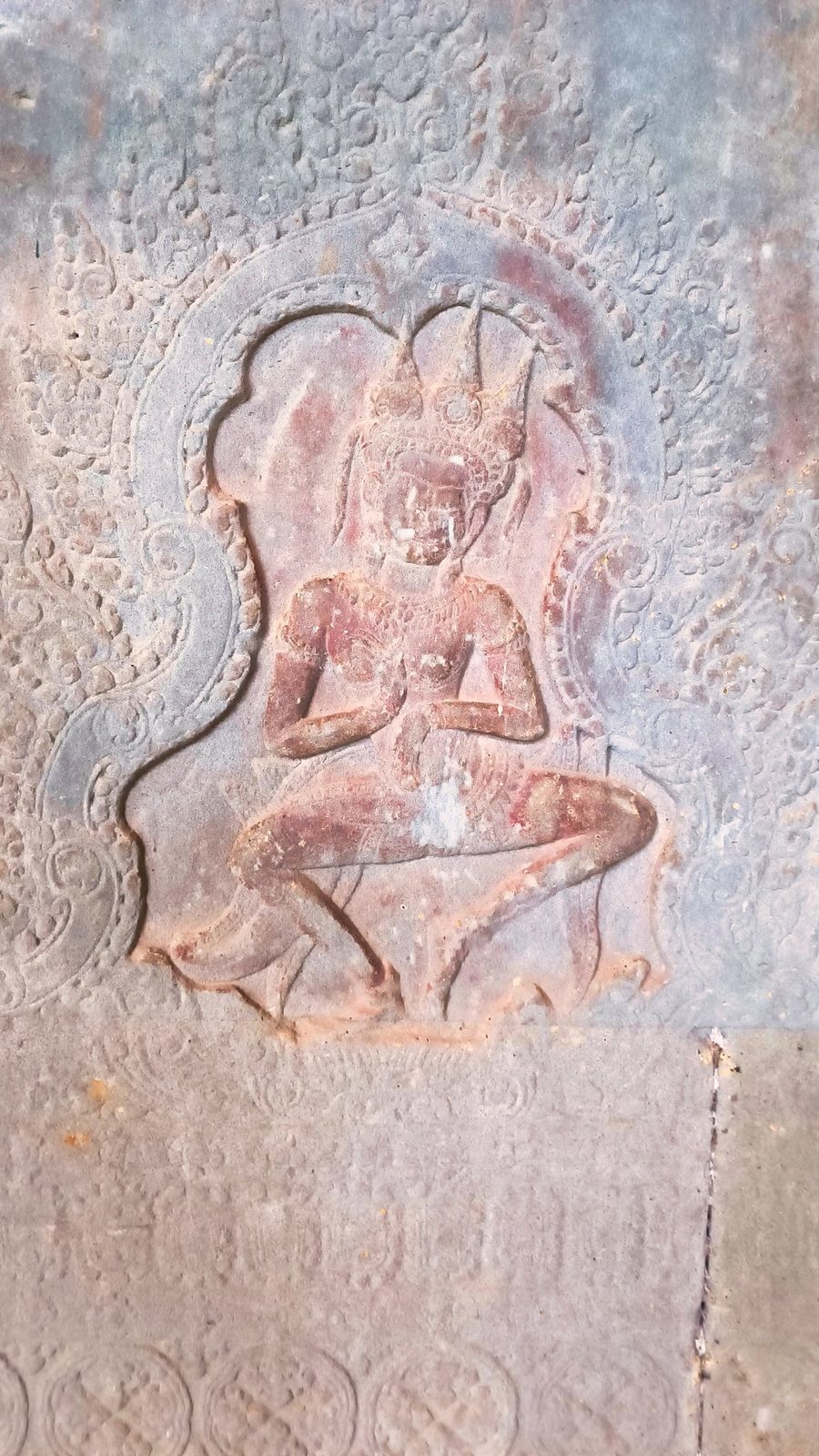
An apsara, carved mid-movement.
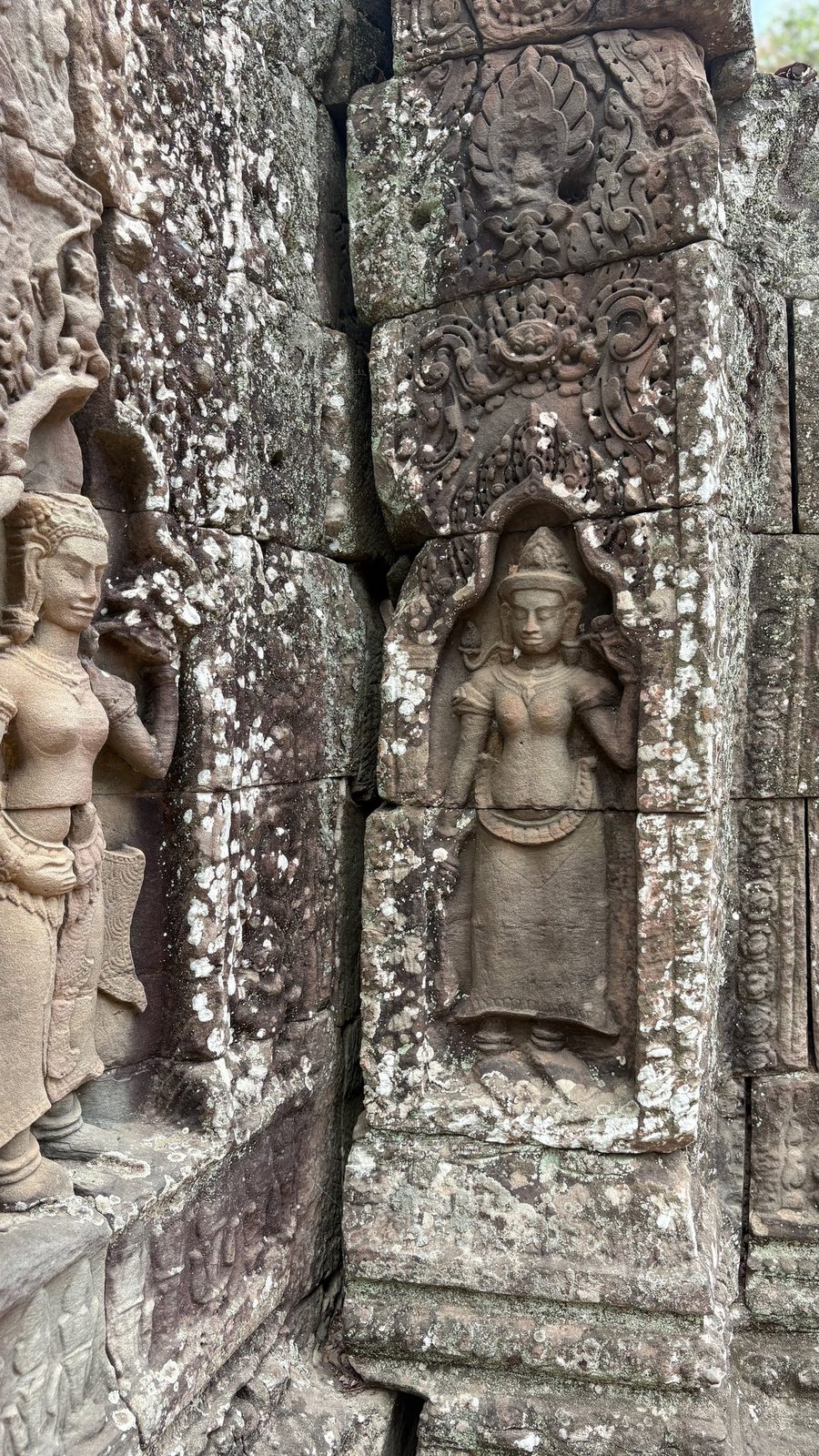
Two devatas, side by side, no two faces alike.
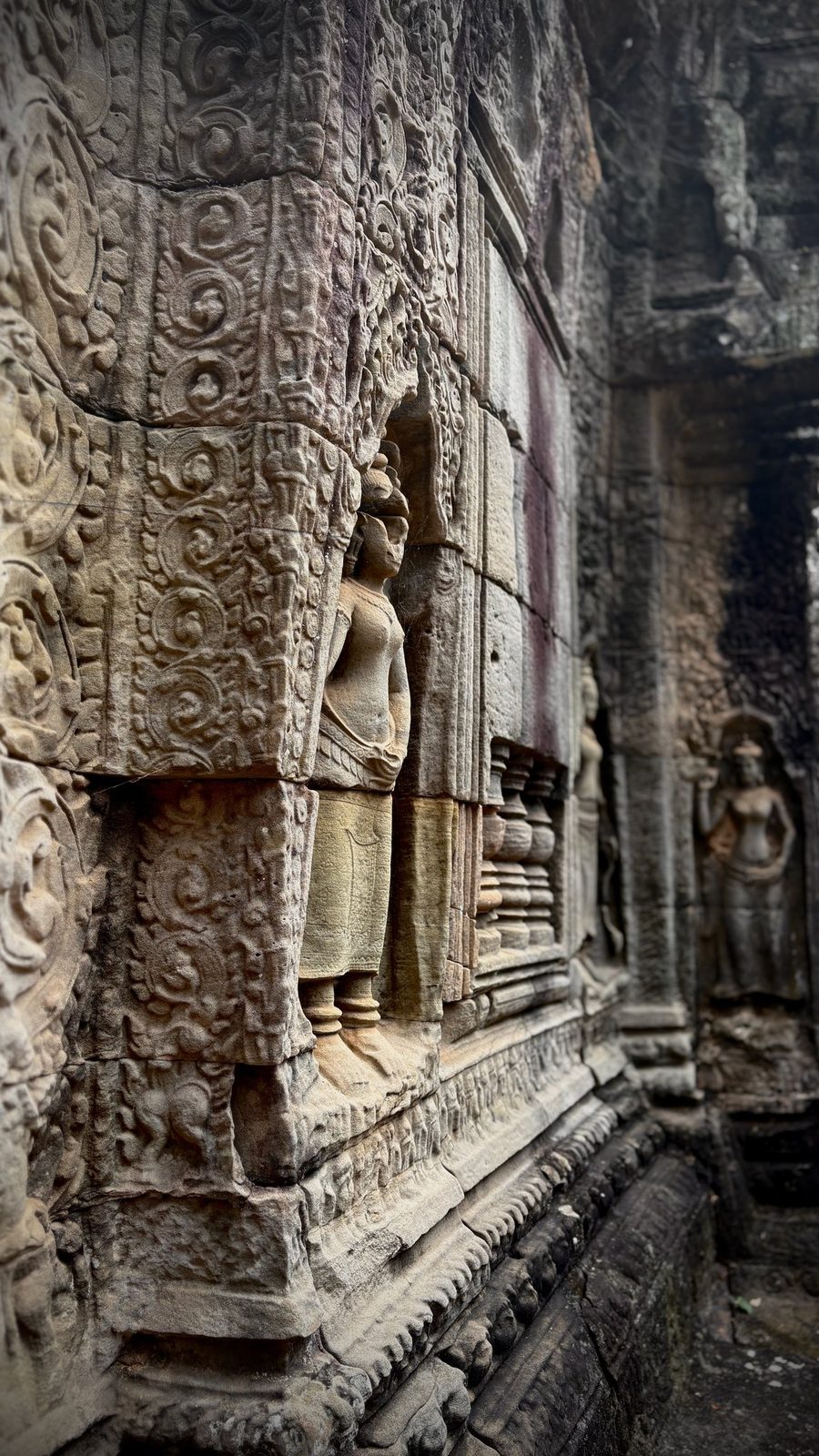
A devata beside one of the temple’s carved windows.
How to See the Bas-Reliefs Without Rushing Them
Give the gallery an hour. That is the single most useful thing I can tell you. An hour is enough to walk all eight panels at a real pace, and enough to sit with the Churning of the Sea of Milk for as long as it deserves. If you only have twenty minutes, do not try to see all eight. Pick three: the Churning, the Army of Suryavarman II, and the Battle of Kurukshetra. Walk straight to them.
One comfort: the gallery is roofed. While the open courtyards of Angkor Wat turn into an oven by mid-morning, the bas-relief gallery stays shaded and walkable. It is a good place to be at 11 AM when everyone else is wilting. Light comes in sideways through the row of pillars on the outer side, so the carving reads differently as the sun moves. There is no bad time of day for it.
The panels are mostly unlabelled. There is no caption telling you this is Kurukshetra and that is Lanka. Without the stories, the whole gallery flattens into one long battle. This is the honest case for a guide, and it is why our private Angkor tours build real time into the gallery instead of marching through it. A good guide does not recite the panel. A good guide stops you at the three figures that matter and lets the rest go. If you are planning the wider visit, our guide to visiting Angkor covers tickets and timing, and the bas-relief gallery sits naturally inside a Small Circuit day.
Why the Carvings Still Matter
Run your eye along the bottom of the Churning panel and you will see the stone has gone dark and glossy, almost like polished bronze, at the height of a human hand. Glaize gave two explanations for that sheen: the rubbing of countless visitors’ hands over the centuries, or the remains of an old lacquer. Both may be true. Either way, it is a record of touch. Every hand that ever steadied itself against that wall left a fraction of the shine.
That is what these eight panels really are. Not a museum display behind glass. A wall that a 12th-century king commissioned, that carvers finished and others left unfinished, that pilgrims walked, that my grandfather knew, and that you can still put your eyes a hand’s width from. The stories are Indian; the hands that cut them were Khmer. And the wall is still here, still being read, nine hundred years on.
Frequently Asked Questions
How long do you need for the Angkor Wat bas-reliefs?
About an hour to walk all eight panels properly, with time to stop at the Churning of the Sea of Milk. If you only have twenty minutes, see three: the Churning, the Army of Suryavarman II, and the Battle of Kurukshetra.
Which bas-relief panel is the most important?
The Churning of the Sea of Milk, on the east gallery. It is nearly 50 metres long, the finest carving in the temple, and the story of gods and demons forced to cooperate is the easiest to follow on the wall.
Can you photograph the bas-reliefs?
Yes. The gallery is dim, so a steady hand helps and flash is discouraged because it flattens the carving. Honestly, the panels reward looking more than photographing. Take a few frames, then put the phone away.
Are the bas-reliefs original?
Mostly, yes. The carving dates to the 12th century, the reign of Suryavarman II. The three panels in the northeast were left unfinished by the original builders and completed by later hands, and you can see the drop in quality. Some damaged sections have been repaired over the years.
Do you need a guide for the bas-reliefs?
It makes the difference between a long grey wall and eight stories. The panels are not labelled, and the scenes are hard to read without knowing the epics. A guide, or this article read beforehand, turns the gallery from a corridor into the reason you came.